
How we are making affordable energy a reality for millions of households
Our new Purpose Coalition report reveals how more than £200million of targeted support, battery innovation and local energy projects are helping tackle the UK’s growing cost-of-living challenge
The success of Britain's clean energy transition will not be measured solely by emissions reduced or renewable capacity installed.
It will be judged by something far more immediate for millions of households – whether energy becomes more affordable.
This is one of the central conclusions of Powering Fairer Energy: E.ON & The Purpose Coalition Breaking Down Barriers Impact Report 2026, the latest paper produced by us and The Purpose Coalition, which sets out exactly why affordability must sit at the heart of the UK’s energy transformation.
The report paints a picture of an energy system in transition, but also of how we as an organisation are increasingly focused on ensuring the benefits of change reach the households most likely to be left behind as it progresses.
For us at E.ON, affordability is not a standalone initiative.
It is a guiding principle shaping everything from customer support and debt relief to battery technology, housing design and local energy markets.
As the report states, we have provided more than £200million in targeted support to vulnerable customers over the past three years, including approximately £75million in the last year alone.

This reflects the scale of need among customers facing financial hardship, health challenges and energy debt, and demonstrates the company’s commitment to providing both immediate relief and longer-term support.
As the report states: “E.ON has also rethought how it communicates with customers in debt or distress. Working with the Money and Mental Health Policy Institute, the company has redesigned its debt communications to make them more accessible and less intimidating, changing tone, language and even visual design to improve engagement and reduce anxiety.
“Together, these initiatives reflect a shift from reactive support to proactive, personalised care, helping ensure that those most in need are not left behind in the energy transition.”
Supporting those who need it most
The scale of the challenge is significant.
Around 40 per cent of our residential customer base – approximately two million people – are registered on the Priority Services Register.
Of those, around one million are classified as high-risk or vulnerable, often facing a combination of financial hardship, health conditions and energy debt.
This is what has prompted us to provide more than £200million in targeted support to vulnerable customers over the past three years.
And the support extends well beyond traditional energy assistance.

Through our Energy Fund, customers can access debt relief, grants, flexible repayment arrangements and help replacing inefficient or broken appliances such as fridges, cookers and washing machines.
The Purpose Coalition report highlights how we have has increasingly moved towards personalised support.
Customers identified as highly vulnerable are automatically directed to specially trained teams, while the company’s Next Care platform enables a “tell us once” approach which reduces the burden on customers repeatedly having to explain their circumstances.
We have also expanded partnerships with organisations including Mind, Macmillan Cancer Support, National Energy Action, the Consumer Energy Debt Advice Service and The Wise Group.
These partnerships reflect a growing recognition fuel poverty rarely exists in isolation.
Instead, it is often intertwined with wider challenges around health, housing, debt and income.
Beyond crisis support
While immediate financial assistance remains essential, the report argues long-term affordability will increasingly come from changing how energy is produced, stored and used.
A major focus is energy flexibility – technology enabling households to shift electricity consumption to cheaper periods automatically.
Partnerships with organisations such as KrakenFlex and Amber Electric are helping customers take advantage of real-time energy pricing, while new automated systems can optimise consumption without requiring active intervention from households.
The ambition is substantial.
As the Purpose Coalition report states, we are developing solutions which could ultimately make flexibility benefits accessible to more than 10 million people across the UK, including households that do not own electric vehicles or solar panels.
Batteries and the battle against fuel poverty.
Perhaps the most striking examples of our work in the report involve battery technology.
In Coventry, we have already demonstrated how battery storage combined with time-of-use tariffs can reduce household energy bills by an average of £250 a year.
We are also now scaling that learning through a partnership with Glasgow City Council and The Wise Group, targeting families experiencing acute affordability pressures as part of Glasgow’s Child Poverty programme.
The initiative combines free home battery systems with energy-efficiency improvements, debt support and tailored family assistance.
And the potential impact is huge.
We estimate participating households could reduce electricity costs by up to 30 per cent through battery technology alone.
The Purpose Coalition report argues projects like these demonstrate how clean energy technology can become a practical anti-poverty intervention rather than simply an environmental solution.
Designing affordability into homes
The research also highlights how affordability is increasingly being built directly into new housing developments.
At Avalon Grove in Worcestershire, delivered with Cotswold Oak Homes, our Lower Bills, Built In model – shown below – integrates rooftop solar panels, battery storage and smart energy management systems into every property.

According to the Purpose Coalition report, such integrated solutions can reduce household energy costs by as much as half in some cases.
Importantly, we are also exploring financing models designed to remove upfront costs and widen access to these technologies beyond higher-income households.
A different measure of success
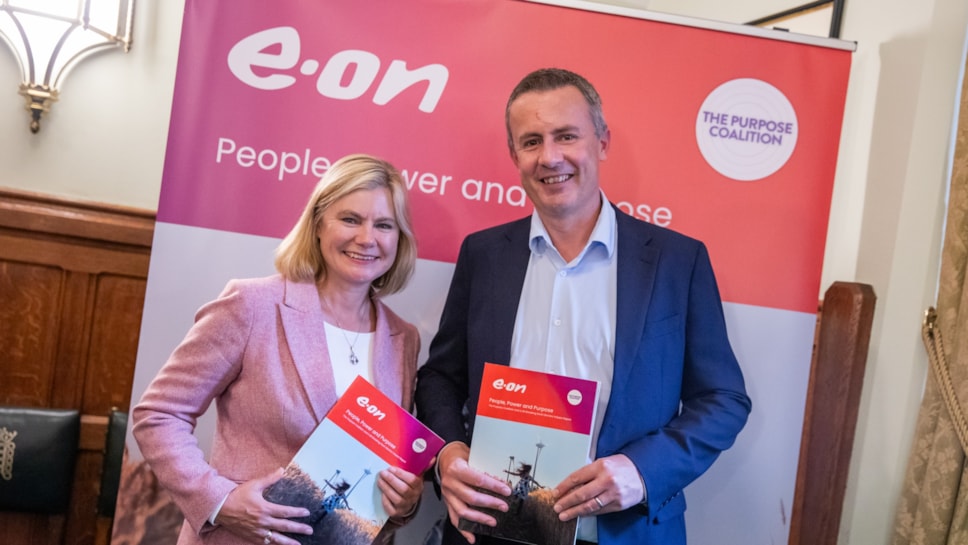
The Rt Hon Justine Greening, Chair of The Purpose Coalition – pictured below launching The Purpose Coalition Report with E.ON UK’s CEO Chris Norbury – believes affordability must become one of the defining measures of progress during the next phase of Britain's energy transition.

She said: “The next phase of the UK’s energy transition must be judged not only by emissions reduced, but by bills lowered, homes improved, high-quality jobs created, future skills developed and communities strengthened.”
Ms Greening added: “E.ON’s purpose, to make new energy work for everyone, is therefore not just a corporate statement. It is a practical challenge and a vital contribution to Britain’s future.”
Chris said: “For E.ON, the clean energy transition is not simply about technology. It is about people. It is about helping customers reduce bills, supporting those in vulnerable circumstances, giving households greater control over their energy, and ensuring that the benefits of cleaner energy are shared as widely as possible.”
The Purpose Coalition report ultimately presents affordability as both an economic and social challenge.
By combining targeted support, technological innovation and place-based partnerships, we know the clean energy transition can become a route to greater resilience and opportunity rather than another source of inequality.
If Britain’s energy future is to work for everyone, affordability will be where that ambition is ultimately tested.
To read the full 2026 Purpose Coalition report, click here.
Legal information
The information (including any forecasts or projections) contained in these press releases (the "Information") reflects the views and opinions of E.ON on the date of the press release. The Information is intended as a guide only and nothing contained within these press releases is to be taken, or relied upon, as advice. E.ON makes no warranties, representations or undertakings about any of the Information (including, without limitation, any as to its quality, accuracy, completeness or fitness for any particular purpose) and E.ON accepts no liability whatsoever for any action or omission taken by you in relation to the Information. Any reliance you place on the Information is solely at your own risk. These press releases are the property of E.ON and you may not copy, modify, publish, repost or distribute it without our permission. © E.ON 2026
Download images from our media library.