
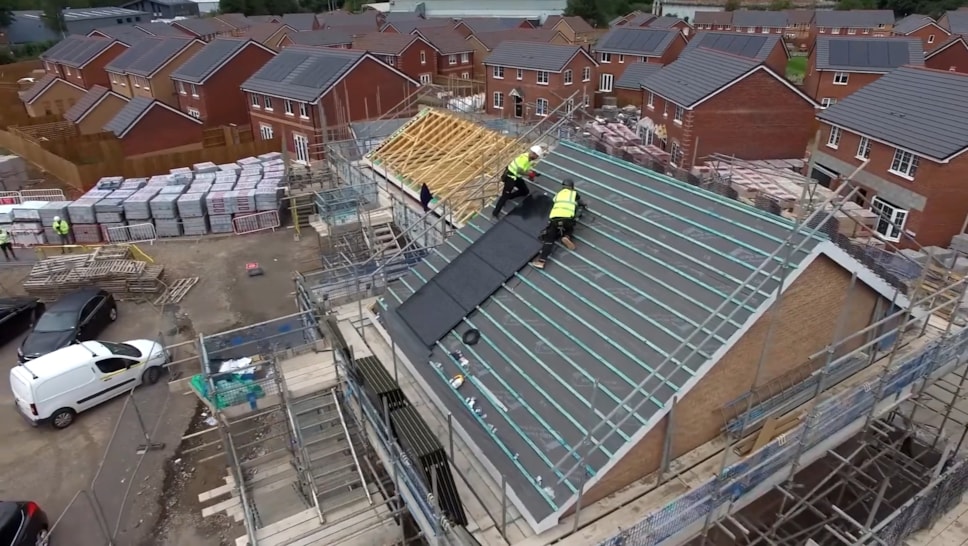
Solar eclipses other low-carbon technologies as the most wanted asset for people buying newly built houses
- Three-quarters of Brits (75%) would rather buy a newly built house with solar panels than one without
- More than two thirds (68%) want to see solar panels on all new houses
Three‑quarters (75%) of people are more likely to buy a newly built house fitted with solar panels than one without, according to new research commissioned by E.ON UK.
The nationally representative survey of 2,500 adults also found widespread support for solar panels to become a requirement for all newly built houses. More than two thirds (68%) back a government mandate for solar panels on all newly built houses, signalling strong consumer demand for renewable power generation.
The findings come ahead of the government’s publication of the new Future Homes Standard (FHS), a major update to building regulations designed to ensure new homes are built to higher energy efficiency standards, with rooftop solar expected to play a significant role.
Solar is Britain’s most wanted low-carbon technology
Solar panels were revealed as the clean energy solution people most want to see on newly built houses – well above other low-carbon technologies:
- Solar panels (72%)
- Heat pumps (41%)
- Electric vehicle charging (41%)
- Battery storage (38%)
Solar panels were also shown to be highly influential at the point of purchase. Two thirds of respondents (66%) said they would consider paying a small increase in purchase price for a newly built house if it guarantees lower energy bills for the long term.
Similarly, four in five people (80%) said newly built houses that allow them to generate and manage their own energy are appealing, while 85% said that having predictable, fixed electricity costs was important when choosing a home.
Despite such high expectations for new houses to include energy‑saving features as standard, awareness of the Future Homes Standard remains low - just 13% of people have heard of it. Yet 87% believe government policy should ensure new homes are designed to cut energy bills, highlighting the importance of standards that reflect buyers’ requirements.
Chris Norbury, CEO of E.ON UK, said: “It is clear people expect low-carbon technologies as standard in new-build houses. They are switched on to what smart home solutions can do for them, and our research shows they understand solar panels can help maximise savings by generating the energy needed to make the most of other assets such as batteries and heat pumps.
“The Future Homes Standard is a vital opportunity to ensure new houses aren’t just energy efficient on paper, but designed to help people take control of their energy use and lower their bills. This cannot be achieved without solar panels. By mandating solar panels in quantities that deliver sufficient generation for each property, the government has an opportunity to help people significantly cut their energy bills while reducing network pressure, increasing energy security and creating more green jobs.”
A typical new build home without any additional energy features pays around £1,797 a year for power and heating. Adding the minimum solar required under current Part L standards reduces this by around £100. However, installing additional solar alongside a battery, a heat pump and smart energy controls, and placing the home on E.ON Next’s Lower Bills, Built In proposition, can reduce annual bills to around £600*. This highlights the much greater impact of a fully electrified, renewable powered home.
Legal information
The information (including any forecasts or projections) contained in these press releases (the "Information") reflects the views and opinions of E.ON on the date of the press release. The Information is intended as a guide only and nothing contained within these press releases is to be taken, or relied upon, as advice. E.ON makes no warranties, representations or undertakings about any of the Information (including, without limitation, any as to its quality, accuracy, completeness or fitness for any particular purpose) and E.ON accepts no liability whatsoever for any action or omission taken by you in relation to the Information. Any reliance you place on the Information is solely at your own risk. These press releases are the property of E.ON and you may not copy, modify, publish, repost or distribute it without our permission. © E.ON 2026
Download images from our media library.