
Five ways to put communities at the centre of the energy transition
Communities across the UK are finding new ways to generate and share their own clean power - helping schools, households and public buildings reduce energy costs and build local resilience, and keeping benefits within the community
From homes and businesses to schools, hospitals and across whole neighbourhoods, ensuring more people can benefit from more affordable, cleaner energy is the aim when it comes to developing community energy projects.
Community energy goes beyond generation, it’s about fairness, access, and affordability – giving people more control over their homes while keeping value local. By supporting households with smart technology and decarbonising public buildings, E.ON is showing how practical, local action can drive a cleaner, fairer energy future.
St Luke’s Primary School community energy project
Rising energy costs and limited access to affordable renewable power can make it difficult for communities to benefit from the energy transition. Despite the strong potential for rooftop solar in schools and public buildings, upfront costs and regulatory barriers often restrict local energy sharing.
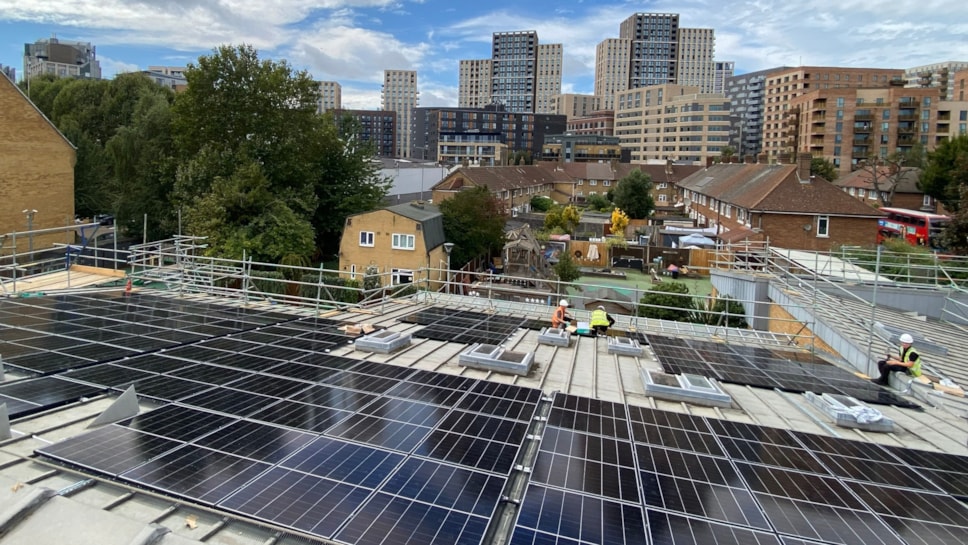
E.ON Next funded and installed 221 solar panels at St Luke’s CEVA Primary School in London. Using smart metering technology, the solar energy can be used within the school and also 'shared' with nearby homes at a reduced price at specific times. The system generates around 92,000 kWh each year - more than half of the school’s energy needs and saving the school and community more than £6,500 per year, while reducing carbon emissions.
“The most important part of the project for us is being able to help families in this area of disadvantage reduce their bills, so they can stay warm for less money.” – Matt Hipperson, Headteacher of St Luke’s CEVA Primary School, Canning Town.
By turning a local school into a clean energy hub, the project keeps both power and financial benefits within the community. It demonstrates how shared renewable generation can lower bills, make the most of 'home grown' electricity, and make a cleaner energy system more inclusive and accessible.
Making clean energy accessible for people in flats
E.ON UK invested in Allume Energy to help bring its SolShare technology to more homes across the UK. SolShare allows solar power from one rooftop system to be shared fairly between multiple households in the same apartment building, removing the technical and ownership barriers that have historically stopped people in flats from accessing solar energy.
The investment supported Allume's UK growth and aligns with E.ON’s goal of making clean energy more inclusive and more affordable. With more than five million households living in low‑ and medium‑rise flats, many social housing, SolShare opens up access to cheaper, cleaner power for communities who have previously missed out. Previous installations have shown shared systems can cut residents’ energy bills by 30-60% while reducing carbon emissions and increasing local renewable generation.
Because SolShare distributes energy 'behind the meter' (before the meter tracks and charges for their use of energy from the grid), residents can keep their existing supplier and benefit automatically from the shared rooftop system. More than half of Allume’s UK projects are already with social housing providers, making this a true example of community energy - one shared renewable installation delivering savings, sustainability and greater energy independence to multiple households at once.
Public buildings, public services
Coventry City Council and E.ON have upgraded six community buildings across the city through a £1.8m investment, installing measures such as solar panels, heat pumps and low energy lighting.

Delivered through the Strategic Energy Partnership Between E.ON and the city council, these improvement are modernising and decarbonising key public hubs – Moat House Leisure Centre, Foleshill All Family Hub, Foleshill Library, Coundon Family Centre, Bell Green Library and the Wilfred Spencer Centre – not only saving more than 120 tonnes of carbon emissions each year, or generating the equivalent of 113 average homes' electricity use, but equally importantly cutting operating costs by around £40,000 a year, delivering more than £2.75m in long-term financial benefits.
That is money that can be redirected into other services that benefit the community.
This project is just one that demonstrates how practical solutions are already improving energy efficiency across Coventry, building and transport systems – building a cleaner, more resilient city that is ready to lead on climate action, support economic growth, and improve quality of life for all.
Saving energy for a cloudy (or less windy) day
Batteries are becoming an increasingly powerful way for households to cut bills and gain more control over their energy use. But for many communities, especially those affected by fuel poverty, the upfront costs and complexity of clean technologies can put these benefits out of reach. Without targeted support, vulnerable households risk being left behind in the transition to cheaper, cleaner energy.
That’s why E.ON Next partnered with Northern Powergrid to deliver a community‑focused battery project in areas with high fuel‑poverty rates. By providing free batteries and insulation, the project allows households to store cheaper off‑peak electricity ready for use at peak times when prices rise. It also means the batteries can reduce pressure on the local power grid. This coordinated approach delivers lower bills, improved comfort and greater energy resilience for the community as a whole.

Similar projects include E.ON Next's enhanced battery trial in Coventry, where households could save up to £360 a year - £100 more than the previous trial - off their energy bills.
Building on the successful 2024 Coventry pilot and running alongside a similar scheme in Glasgow, the new phase initially supported up to 100 households. Eligible customers received free batteries, access to time‑of‑use tariffs and smart optimisation technology - all designed to make affordable, green energy solutions accessible without any upfront costs, with plans to expand the programme in later phases.
These learnings are now informing larger innovations such as Next Gen Home that bundles solar, batteries, heat pumps, EV chargers and smart energy management into one simple offer. By removing upfront costs and designing energy systems around people, Next Gen Home shows how low‑carbon living can become easier, more affordable and accessible for many more households.
Together, these community‑driven projects highlight a meaningful shift: clean, reliable and affordable energy becoming something everyone can benefit from, not just those able to invest.
Greener hospitals, healthier communities
It is not only households and small community hubs that can play a role in the energy transition; large, energy-intensive public buildings can also adapt and benefit.
Hospitals sit at the heart of communities, providing essential care and safeguarding public health. However, with heating, cooling, and lighting systems operating around the clock, they also consume significant amounts of energy.

At the Queen’s Medical Centre in Nottingham, E.ON is delivering long-term environmental and social benefits with a new geothermal heating and cooling system, new double-glazed windows, and advanced building controls to improve efficiency and performance.
The improvements are already making a difference. Staff feedback highlights increased natural light, improved warmth and comfort, and a quieter environment; enhancing working conditions and patient experience. At the same time, the new low-carbon heating and cooling system is expected to significantly reduce emissions while lowering operational costs – money that can be diverted into patient care instead of energy bills.
Overall, the partnership demonstrates how decarbonising major public infrastructure can both support national climate goals and strengthen the communities these institutions serve.
Energy today is about more than generation – it’s about fairness, access, and affordability. As energy costs remain a national concern and the UK accelerates towards net zero, community energy can give people greater control over how their homes and shared spaces are powered, ensuring benefits such as lower bills and local investment are felt where they matter most.
Through projects like these, E.ON is showing how combining technology, expertise and strong local partnerships turn ambition into action – placing communities at the heart of a cleaner, fairer energy future.