
Where football’s future begins
As millions look to the game's biggest stage this summer, E.ON is helping build the values, confidence and opportunities that shape young lives in community clubs across England
With another summer of football capturing the world's attention, it’s easy to believe the game belongs to grand arenas, TV cameras and global stars.
For the next few weeks, the sport will be a spectacle measured in packed stadiums, international rivalries and moments watched by millions.
But long before any player walks onto the world stage, football begins somewhere else entirely.
It begins under floodlights on cold evenings and in village clubhouses.
It begins in changing rooms painted by volunteers and communities where parents become coaches, committee members become fundraisers – and where local clubs become the beating heart of their neighbourhoods.
Because football’s real host nation is far larger than any country, it is every grassroots club that keeps the game alive.
And it is in those clubs – the foundation of the sport – where the next generation of players, supporters and future leaders are being shaped.
Where football really lives
Few people understand that journey better than Stuart Pearce. With 78 England caps and a career which has made him one of the most respected figures in English football, Pearce’s story began not in a national stadium but on local pitches much like those found in communities across the country.
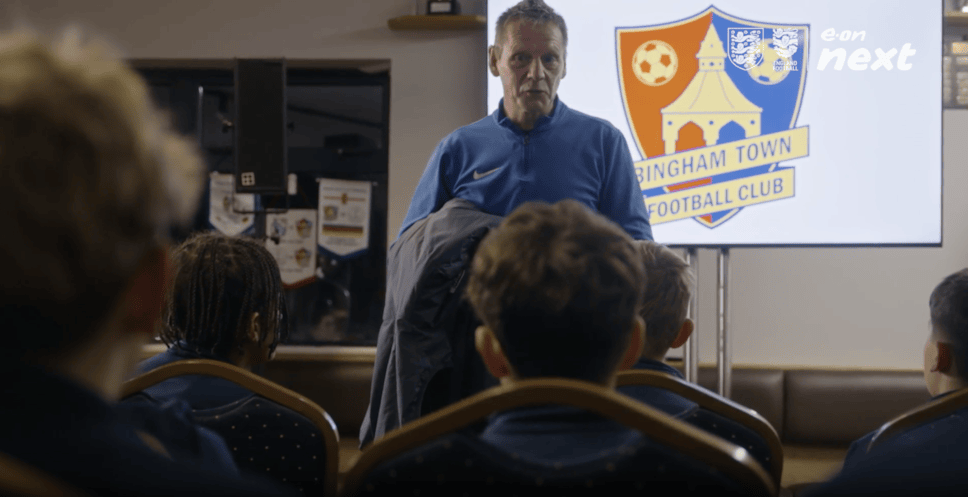
That is why, when we arranged a surprise visit to Bingham Town FC in Nottinghamshire through England Football’s Greener Game programme, supported by E.ON Next, the message he delivered to young players was refreshingly simple.
“I said I'd pop along and just try and inspire you,” Pearce – seen above on his visit – told the club’s excited junior team before training.
Facing an important match, he told the youngsters how they could confidently win their next big game.
Pearce also told the eager kids: “If you train really hard and listen to your coach, then we've got every chance of winning the game.
“Eat, sleep and train harder than the person you're playing against.
“It’s amazing how far it will get you in the game.
“You have to play with a smile on your face, and don’t forget it’s a team game.”
The advice was not about fame, contracts or trophies.
It was about effort, discipline and teamwork – the same qualities grassroots football develops in thousands of young people every week.
The Greener Game goes far beyond helping instill these thing – it is about sustainability.
More than football clubs
Across the country, grassroots clubs perform a role extending far beyond sport.
They are social hubs.
They are places where confidence is built, friendships are formed and communities come together.
For many young people, their local football club becomes the first place where they learn responsibility, resilience and what it means to work as part of a team.

These are qualities that matter far beyond the touchline.
They shape futures.
They help young people navigate school, work and life.
And increasingly, they help prepare the next generation for a rapidly changing economy.
Investing in the next generation
The connection between football and future opportunity is often overlooked.
Yet the qualities developed through sport – teamwork, communication, resilience, leadership and problem-solving – are also the skills needed in modern workplaces.
That thinking also sits at the heart of E.ON Next’s Kids in Sport programme.
Over recent years, the initiative has been brought to schools across the UK, combining sport with practical experiences in sustainability, coding, communications, technology and science.

Football drills have sat alongside renewable energy challenges.
Sporting activities have been paired with STEM learning.
Children have explored not only sporting careers, but the vast network of professions that help modern sport function behind the scenes.
The aim is straightforward: to show young people what is possible.
Protecting the places that matter
For many grassroots clubs, financial pressures remain a constant challenge.
Rising costs can put strain on facilities that communities depend upon.
That is why the Greener Game focuses not only on supporting football but on helping clubs become more sustainable and energy efficient.
The programme helps eligible clubs explore ways to vastly reduce energy costs and lower carbon emissions – creating savings which could be reinvested back into facilities, equipment and community programmes.
The stars of tomorrow
This summer, football will dominate conversations across the country.
Young players will watch from living rooms, clubhouses and sidelines, imagining themselves on the biggest stages in the game.
The value of football has never been measured only by the number of professional players it produces.
It’s measured in the confidence a child gains from joining a team, in the friendships formed on training nights and in the lessons gained on learning how to win, lose, work together and keep going.

At Bingham Town FC, Stuart Pearce’s message to the young players wasn’t about fame or success – it was about simple effort, enjoyment and being part of a team.
That’s what grassroots football does at its best.
It gives young people a place to belong and the chance to grow. And that’s why supporting local clubs and schools matters.
Because every week, on pitches and in clubhouses across the country, they’re helping shape the next generation, whatever path they go on to follow.
And the support it brings to young people is why we are so proud to keep backing grassroots clubs and schools.
Click here for information on how to join the Greener Game today and see how eligible clubs have the power to save money and energy.
And click here to learn about our Watch & Wash campaign – which sees England legends highlight £93million in potential fan savings tied to off-peak electricity use around this summer’s kick-offs.
Legal information
The information (including any forecasts or projections) contained in these press releases (the "Information") reflects the views and opinions of E.ON on the date of the press release. The Information is intended as a guide only and nothing contained within these press releases is to be taken, or relied upon, as advice. E.ON makes no warranties, representations or undertakings about any of the Information (including, without limitation, any as to its quality, accuracy, completeness or fitness for any particular purpose) and E.ON accepts no liability whatsoever for any action or omission taken by you in relation to the Information. Any reliance you place on the Information is solely at your own risk. These press releases are the property of E.ON and you may not copy, modify, publish, repost or distribute it without our permission. © E.ON 2026
Download images from our media library.