
The everyday heroes powering England’s football dreams
From lifts from a helpful neighbour to the terror of the first game and joy of early trophy ceremonies... England stars tell E.ON Next about the quiet community behind their rise – revealing why protecting grassroots clubs through the Greener Game scheme matters more than ever
Every top footballer remembers their first pitch.
Not the glamorous stadium with its roar and glare, but the grassroots one – floodlights humming against a winter sky, mud thick around the goalmouth and a handful of parents and volunteers gathered along the touchline.
It is there most football stories truly begin.
Before contracts and caps, before televised kick-offs and packed stands, there are early evenings on community fields.
First touches. First nerves. First tears.
And almost always, someone standing quietly on the sideline willing it all to go well.
Grassroots football is sustained by these everyday heroes – the people who drive the extra miles, organise the kit, unlock the clubhouse and keep the kettle warm after the final whistle.
Sometimes it is a parent.
Sometimes it is a coach or neighbour.
And sometimes it’s a friend’s parent who simply makes room in the back seat for one more hopeful player.
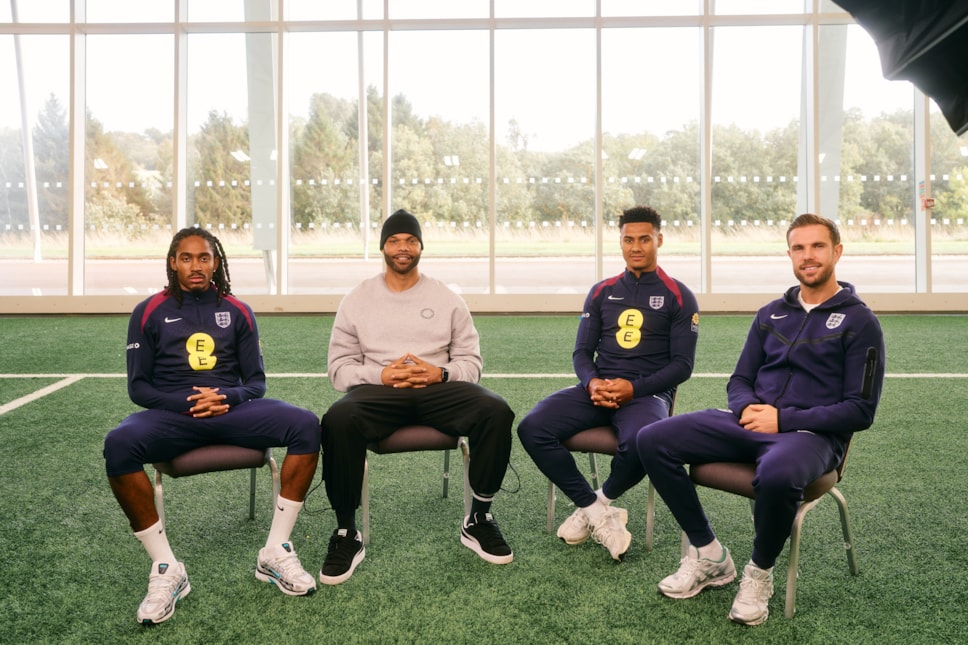
The journeys of England internationals Jordan Henderson, Ollie Watkins and Djed Spence began exactly like that.
Long before the spotlight of elite football found them, their stories were being written on community pitches across the country.
In partnership with E.ON Next, former England defender Joleon Lescott recently sat down with the three players to revisit those early memories – their grassroots years before global recognition.
And as the video of their chats show – which you can watch below – what emerged were not stories of wonder goals or career-defining moments.
Instead, they highlighted something far more revealing: the people and communities who helped make their journeys to the top possible.
Jordan’s earliest memory of football is not one of triumph but uncertainty.
“I started playing when I was maybe six,” he said. “I can remember the first game – I think I ran off at half time crying. I didn't know what to do, but then after a few games I settled and enjoyed it straight away.”
It is a reminder that every football career begins with vulnerability.
The difference between stopping and carrying on often lies not in talent but in encouragement – the reassurance offered from the sidelines.
Jordan’s journey began at Fulwell Juniors in Sunderland, a grassroots club like thousands across England where children first learn to play – and where they often learned something else vital too.
“It does bring communities together regardless of colour or background or anything,” he reflected on his time in grassroots football.
He added: “And I think it's a really good way of learning about stuff like that, when you're young.”
Those early pitches, after all, are classrooms as much as playing fields.
“Back then, it was just about having fun, with your friend kicking the ball about and enjoying football,” Jordan added.
But he stressed: “Alongside that, without you realising, you inherit teamwork, skills, discipline.”
For Ollie Watkins, the road to the top depended on the quiet generosity of someone outside his own household.
The striker began his grassroots journey at Newton Town FC in Devon, but simply getting to training required help.
“My mum was working in the evenings – my parents had separated,” he said. “So I was always reliant on my best mate’s dad to give me a lift. Without him, I probably wouldn’t have been able to make training.”
It is a small act – a lift in the car after school – but one that carries enormous weight when repeated week after week, season after season.
Grassroots football is full of these unseen contributions: the extra pair of gloves packed into a kit bag, the late drive home from an away game, the volunteer who marks out the pitch in the rain before anyone else arrives
“All the professionals that you see playing today have always had to start off from there,” Ollie said of grassroots clubs. “So just enjoy it.”
Djed Spence’s first steps in the game came at Junior Elite FC in South London – another grassroots club whose influence extends far beyond the pitch itself.
He fondly remembers the rituals that gave young players confidence and motivation.
“There was always a ceremony at the end of the season,” he said. “And I always used to get Improved Player a lot.”
Moments like that – trophies handed out in clubhouses or community halls – have the power to shape a young player’s sense of possibility.
Djed added: “I think it’s great for kids to go somewhere, play for a club and just have fun – enjoy and learn and perfect your craft.”
Joleon, who hosted the conversation with the three England internationals, also recognises those formative lessons instantly.
“My first memory of grassroots was boots,” he said with a smile. “I wasn’t allowed to play if my boots weren’t clean. My boots were clean. My room was a mess – but my boots were clean!”
That simple rule spoke to something deeper: pride in the game, respect for the team, discipline learned long before football becomes a profession.
“The enjoyment of it – just that feeling of playing, regardless of what the outcome could be in terms of your career,” Joleon reflected.
He added: “Just the enjoyment is top.”
But for grassroots football to continue creating these memories, the clubs themselves must be able to survive.
Across England, community clubs sit behind village halls, beside railway lines and on the outskirts of towns.
They are run almost entirely by volunteers and powered by local goodwill – but increasingly they face rising costs that threaten their ability to keep the lights on.
Floodlights, changing rooms, heating and electricity are essential parts of the grassroots experience, yet they are also among the most expensive.
That is where the Greener Game comes in.
The England Football initiative, supported by E.ON Next, was designed to help grassroots clubs reduce energy costs and environmental impact while strengthening the foundations of community football.
Through our free energy audits, expert advice and potential investment in improvements such as LED lighting, solar panels, insulation and battery storage, the programme is now helping clubs cut bills and reduce emissions – freeing up precious resources to reinvest back into the “beautiful game”.
More than 100 clubs have already benefited from free analysis, with some now saving up to 25 per cent on electricity costs.
Hundreds more have signed up to the programme as clubs look for ways to secure their future.
These savings are not abstract figures on spreadsheets.
They are the difference between floodlights switching on for a winter training session or remaining dark.
They are the difference between a youth team registering for the season or folding entirely.
And they are the difference between a child continuing their football journey – or never quite beginning it.
As Joleon puts it, grassroots football nurtures far more than players.
“It develops referees, coaches and physios – it’s important we keep that going,” he said.
Because the story of English football is not written only in stadiums or broadcast around the world.
It begins on small pitches under buzzing floodlights, where volunteers line the touchline and communities gather week after week.
It begins with the everyday heroes who make all that happen.
And thanks to programmes such as the Greener Game, the places where those stories start are being protected for the next generation of players, supporters and dreamers.
Click here for information on how to join the Greener Game today and see how eligible clubs have the power to save money and energy.
Legal information
The information (including any forecasts or projections) contained in these press releases (the "Information") reflects the views and opinions of E.ON on the date of the press release. The Information is intended as a guide only and nothing contained within these press releases is to be taken, or relied upon, as advice. E.ON makes no warranties, representations or undertakings about any of the Information (including, without limitation, any as to its quality, accuracy, completeness or fitness for any particular purpose) and E.ON accepts no liability whatsoever for any action or omission taken by you in relation to the Information. Any reliance you place on the Information is solely at your own risk. These press releases are the property of E.ON and you may not copy, modify, publish, repost or distribute it without our permission. © E.ON 2026
Download images from our media library.