
Targeted battery use could save households hundreds and ease investment pressures on power networks, E.ON modelling shows
Domestic batteries can cut household energy bills in the short term and support investments to meet growing demand on local power networks, new analysis from E.ON shows
Using domestic batteries to support local power networks could cut household energy bills in the short term while easing the strain on distribution grids and helping Distribution Network Operators (DNOs) make more efficient, better‑timed investment decisions, new analysis from E.ON shows.
As electricity demand grows to meet the needs of electrified heating, EV charging and new commercial uses such as data centres, network companies need to rely on future forecasts of where that higher demand will fall, and when it will be needed.
E.ON’s modelling shows a targeted battery approach can complement the need for billions of pounds in major engineering works and reinforcement costs by giving DNOs additional tools to manage these uncertainties.
About 1,400 local substations are expected to reach capacity by 2035, the research shows. Installing batteries in customer homes instead of building new network infrastructure in key locations can unlock new flexible capacity more quickly and at lower cost while reducing the risk of investing in network upgrades that may not ultimately be needed if the forecast demand does not come.
By unlocking flexible capacity in the right locations, batteries can help networks optimise the timing and scale of reinforcement works while delivering immediate consumer benefits by reducing bills for households hosting them – particularly those in fuel poverty.
This ‘firm flexibility’ approach benefits the energy system by supporting DNOs in strategic investment timing, it can promote the acceleration of connections. In some cases, it can reduce or even remove the need for physical upgrades to the network.
E.ON’s analysis, carried out with consultancy Oxera, focused on people living in social housing in areas identified as being at risk of facing grid constraints. This is a way of targeting the greater consumer benefits on those people facing financial hardship. The report shows:
- Targeted battery deployment in social housing could provide up to 77% of the additional local grid capacity the UK will need by 2035, rising to 99% if adopted across all housing types
- £220 yearly bill savings for social households, through bill credits and reduced electricity costs linked to battery flexibility
- Potential to reach 480,000 social households by 2035 if deployed nationwide in areas near constrained substations
- Wide-scale deployment could allow Distribution Network Operators (DNOs) to reduce their gross capital expenditure by £3.3 billion[1] in reinforcement costs over the five-year period between 2028 and 2033
- Even where network upgrades remain necessary, batteries can provide a basis on which they could be significantly delayed by periods exceeding five years, with deferred capex savings of £681m 2
- These savings would feed through into lower network charges, helping all customers with their bills, not just those hosting batteries
- The wider benefits of batteries include helping to balance supply and demand on the transmission network and managing grid supply chain risks.
Britain’s distribution networks already face major challenges: uncertain levels of rising demand, delays to new connections, higher construction costs, stretched global supply chains and a shortage of specialist workers. Prices of transformers, a vital component in electricity grids, have increased 30% in recent years3 and copper cables, another key component, have nearly doubled in the last five years as demand surges4. These pressures all ultimately feed through to customers’ bills.
Across Britain’s 4.1 million social homes, around 1.6 million are expected to sit near constrained substations by 2035. This creates a major national opportunity to pair neighbourhood‑scale flexibility with communities who stand to benefit most from lower bills.
“Flexibility like this delivers capacity exactly where and when it’s needed on the network,” said Ramona Vlasiu, Chief Operating Officer at E.ON Next, “bridging the gap between growing demand for power and the time and the cost it takes to reinforce local networks.
“With network charges rising as a share of bills, we need practical solutions that can make better use of network investment – and by focusing on flexibility, rather than a ‘just build’ approach we could be helping customers today while also doing the necessary work of preparing Britain’s grid for a more flexible, affordable energy future.
“With the right policy signals, we can scale this rapidly and unlock meaningful savings, meaning everyone benefits from reduced costs across the whole energy system.”
How it works
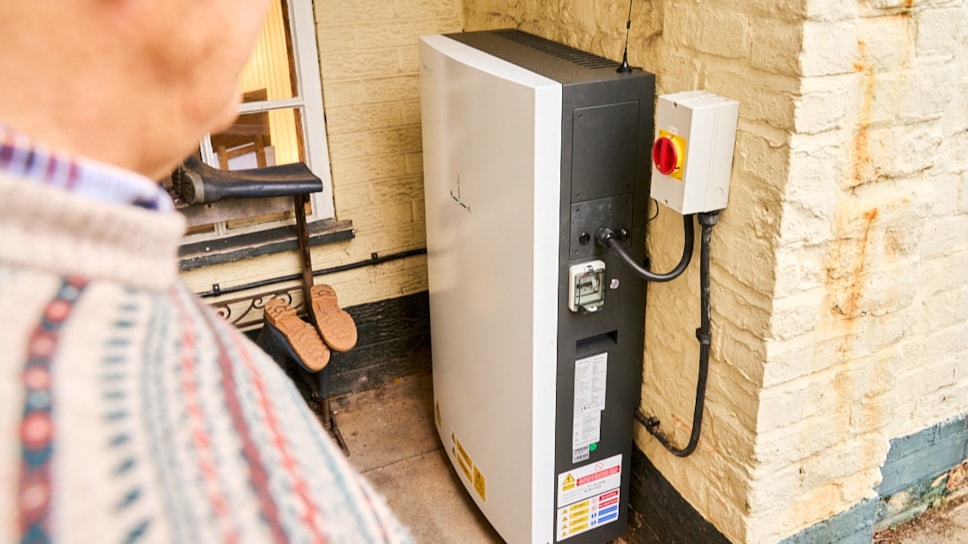
E.ON is trialling a similar approach with Northern Powergrid (NPg) installing small domestic batteries free of charge to selected homes in locations with an existing substation constraint.

These batteries:
- charge when demand is low
- discharge when network demand peaks
- support the household and wider system
- provide guaranteed bill credits to residents
- require no change in customer behaviour
The batteries are controlled remotely to support the electricity network when needed. By using stored energy locally and at the right time, the DNO has a reliable, responsive tool for managing peak load without expensive engineering works.
While the battery works silently in the background, the customer receives a guaranteed bill credit for hosting it without any need to change their behaviour. For customers in fuel poverty, this bill credit provides immediate, tangible support to reduce their cost of living.
RIIO-ED3 is the energy regulator Ofgem's third five-year price control framework which sets revenue allowances and performance targets for the UK’s electricity distribution network operators, running from April 2028 to March 2033. The framework guides how networks invest in meeting net-zero goals, network resilience, and efficiency, including ensuring infrastructure supports increased electrification.
To scale the ‘firm flexibility’ model nationwide, E.ON is calling for Ofgem to support a longer term approach to the use of flexibility to optimise investment in the next electricity distribution price control mechanism, running from April 2028 to March 2033 (ED3):
- Longer term flexibility contracts: DNO flexibility contracts are limited by the fixed five-year price control period. A longer term view of the investment and flexibility profile would optimise outcomes and unlock more private investment.
- Use flexibility services in long term investment scenarios in ED3: In the next price control period, DNOs should be encouraged to use flexibility wherever it offers better long-term value and help to reduce customer bills.
- Collaboration for a market-based solution: Bringing together local authorities, DSOs and energy suppliers would fast-track approvals and allow rapid data sharing to get the most benefit from flexible assets.
- All benefits to be recognised: Regulation should cover and incentivise all the benefits flexibility can deliver, including helping to reduce fuel poverty.
- Bilateral flexibility contracts to be more freely allowed: DNOs should have the freedom to choose how they buy flexibility and assess providers on more than just cost, including their reliability and how well they can deliver.
Notes to editors
1 Based on removing the reinforcement costs of 599 primary substations at £5.5m per substation from the DNO ED3 capital programme, by instead installing batteries in social housing. This is the value of capex that could be deferred. To understand system savings, the cost of procuring DNO flexibility should be subtracted.
2 £681m estimate based on deferring reinforcement capex at 599 substations (92% for 5 years and 8% for 10 years) at a cost of £5.5m per substation.
3 National Infrastructure Commission Electricity distribution networks: Creating capacity for the future, Feb 2025
Legal information
The information (including any forecasts or projections) contained in these press releases (the "Information") reflects the views and opinions of E.ON on the date of the press release. The Information is intended as a guide only and nothing contained within these press releases is to be taken, or relied upon, as advice. E.ON makes no warranties, representations or undertakings about any of the Information (including, without limitation, any as to its quality, accuracy, completeness or fitness for any particular purpose) and E.ON accepts no liability whatsoever for any action or omission taken by you in relation to the Information. Any reliance you place on the Information is solely at your own risk. These press releases are the property of E.ON and you may not copy, modify, publish, repost or distribute it without our permission. © E.ON 2026
Download images from our media library.