
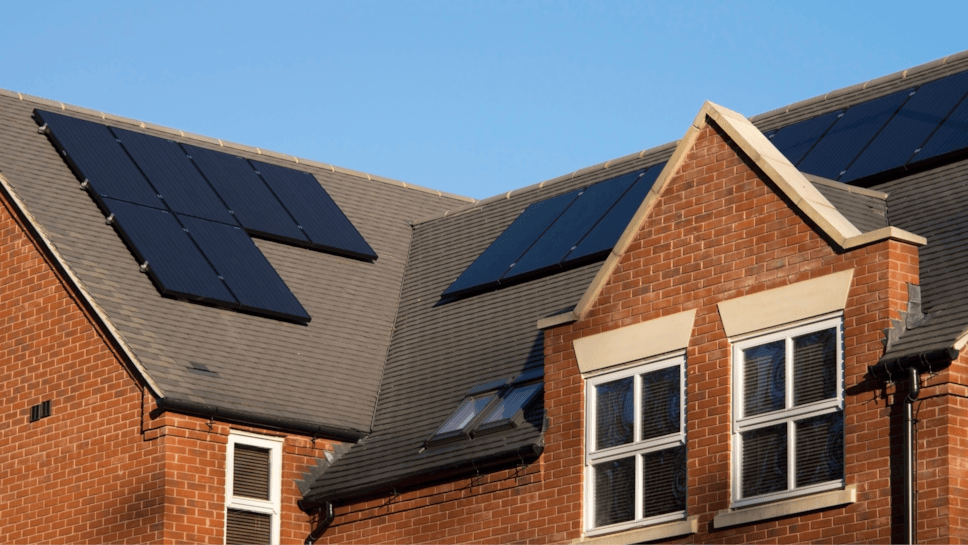
Missing Millions: UK solar households could be missing out on £201m in savings every year
- E.ON Next analysis shows households with solar panels could collectively save up to £201* million a year by adding a home battery
- More than a third (36%) of people with solar panel say knowing how much they could save would encourage them to install a home battery
- People with solar and a battery could further boost savings by up to £452 a year** on E.ON Next’s Next Optimise tariff, potentially delivering up to £650m in additional savings across the UK
New research reveals the savings UK solar homes could be missing out on, as E.ON Next shows how adding a home battery can help them make more of the power they generate.
The analysis shows the 1.78 million*** UK homes with solar panels fitted could collectively save up to £201 million a year on their electricity bills by adopting home batteries. Battery technology allows solar households to store additional electricity they generate to be drawn down later when they need it.
Despite the savings potential, a survey of solar panel owners by E.ON Next suggests many households could be overlooking the opportunity. Half (50%) didn't realise a battery could reduce the amount of electricity they need to buy from the grid, 40% didn’t know it would let them store excess energy to use later and almost a fifth (19%) didn't realise it could help reduce their bills. More than a third (36%) said knowing how much they could save would encourage them to install one.
Pairing a battery with E.ON Next’s Next Optimise tariff could further boost savings by up to £452 a year for a typical solar and battery customer**. As the UK’s first tariff to combine dynamic pricing with automatic battery control, it tracks electricity prices throughout the day, charging the battery when power is cheaper and using it, or selling it back to the grid, when prices are high – which could help households to pay less and earn more.
When questioned, one in five solar panel owners (20%) didn’t know how solar panels, batteries and dynamic tariffs like Next Optimise work together, with nearly a third (31%) not realising that smart tariffs can allow batteries to automatically export and import electricity based on market prices.
Julian Lennertz, Chief Commercial Officer at E.ON Next, said: “More people with solar panels are adding batteries, but many are still not making the most of the power they generate. A home battery works a little like a household freezer – storing excess solar power until it’s needed so households can use more of their own energy and less from the grid.
“Next Optimise makes that battery work smarter, automatically working out when it’s best to store, use or export electricity depending on prices, helping customers lower their bills and take greater control of their energy."
Solar and battery households can find out more about Next Optimise at eonnext.com/tariffs/next-optimise.
For customers who are struggling with their energy bills, E.ON Next offers a range of measures to help, including the E.ON Next Energy Fund, flexible payment plans, the Priority Services Register and extra credit for prepayment customers. To find out more visit eonnext.com/customersupport.
Notes to editors
E.ON recently announced it has completed the acquisition of OVO Energy. There is no immediate change for customers of E.ON Next or OVO - OVO customers should continue to contact OVO with any enquiries regarding their account.
Research of 500 solar panel owners was commissioned by E.ON Next and conducted by 3GEM between 6 November and 11 November 2026.
*"Properties with solar" calculations assume a consumption value of 4,000 kWh per year. Savings are based on properties being fitted with the UK-average-sized 4.0 kWp solar array, generating 3,400 kWh per year, and where appropriate, the system includes a 5.1 kWh (4.6 kWh usable) battery, running in either "solar self-consumption", or "optimised with SmartShift™" modes. Electricity tariff rates are assumed to be 26.32p/kWh for import (the Ofgem Energy Price Cap rate from 1st Oct 2026, with VAT on electricity at 0%), and Smart Export Guarantee (SEG) payments of 13.0p/kWh, or our Next Optimise pricing for the latest full calendar year (2025). Geographical and eligibility restrictions apply.
Ofgem Price Cap rates: https://www.ofgem.gov.uk/your-energy-supply/your-energy-bill/energy-price-cap-unit-rates-and-standing-charges "Dwelling stock estimates" data, from MHCLG dashboard: https://www.gov.uk/government/statistics/dwelling-stock-estimates-in-england-2025/dwelling-stock-estimates-england-31-march-2025 Solar PV "Domestic installations" figures (capacity and count) from DESNZ "Energy Trends" Solar photovoltaics deployment data, 29 Oct 2026 (covers up to end-Sept 2026): https://www.gov.uk/government/statistics/energy-trends-section-6-renewables "Properties with solar" annual consumption values from E.ON Next historic data.
** This is an example saving based on simulations for a 2025 property in the East Midlands with electricity consumption of 4,000 kWh per year (with the customer home all day), fitted with a 12-panel solar array generating 4,950 kWh per year, plus a Sunsynk Elite battery with 10.2 kWh capacity and using the Next Optimise optimisation functionality at all times. For comparison purposes, Next Optimise pricing for 2025 has been adjusted to include our 3p early bird booster and the applicable VAT rate has been set to 0%.
Savings are based on comparisons to a standard electricity import rate of 25.36p/kWh and a standing charge of 51.45p/day, based on the Ofgem Energy Price Cap rates for the East Midlands from 1 Oct 2026, including a VAT rate of 0% on electricity, and Smart Export Guarantee (SEG) payments of 13p/kWh under E.ON Next Export Exclusive v3. Actual costs and savings may vary depending on future energy prices, solar generation, system configuration, the presence of other energy technologies such as an EV or heat pump, energy consumption, and usage of the Next Optimise optimisation functionality. Geographical and eligibility restrictions apply.
***https://www.gov.uk/government/statistics/energy-trends-section-6-renewables
Legal information
The information (including any forecasts or projections) contained in these press releases (the "Information") reflects the views and opinions of E.ON on the date of the press release. The Information is intended as a guide only and nothing contained within these press releases is to be taken, or relied upon, as advice. E.ON makes no warranties, representations or undertakings about any of the Information (including, without limitation, any as to its quality, accuracy, completeness or fitness for any particular purpose) and E.ON accepts no liability whatsoever for any action or omission taken by you in relation to the Information. Any reliance you place on the Information is solely at your own risk. These press releases are the property of E.ON and you may not copy, modify, publish, repost or distribute it without our permission. © E.ON 2026
Download images from our media library.