
Generation EV: Young drivers say petrol cars are as outdated as landlines
- More than half (55%) of young drivers want their first car to be electric, as almost a quarter (23%) say owning a petrol car is as outdated as using a landline.
- Economist reveals new drivers could save £890* in their first year of driving by going electric, as E.ON Next’s Next Drive Smart Tariff offers overnight home charging for less than £8.
- EV expert Robert Llewellyn gives his top tips to help young drivers get on the road in an EV.
- Figures from Select Car Leasing show that electric vehicles now account for more than one in four vehicle leases among under-25s.
Research from E.ON Next reveals today's new drivers are the first generation ready to go electric from day one, as petrol starts to feel like a thing of the past. Data finds 55% of 17 to 20-year-old learner drivers want their first car to be an EV, as almost a quarter (23%) say owning a petrol car is as outdated as using a landline.
According to the study, young drivers cite low day-to-day running costs (20%) as one of the main reasons electric is the way to go, with over half (56%) agreeing having an EV is a money saver. Economic insight shows new drivers could save as much as £890* in their first year on the road by going electric and charging at home with E.ON Next’s Next Drive Smart tariff.
Meanwhile, being able to charge at home (19%), and not needing to visit the petrol station regularly (18%), are among the other reasons EVs hold such strong appeal amongst the younger gen. Figures from Select Car Leasing show that electric vehicles now account for more than one in four vehicle leases among under-25s, up from just one in 20 two years ago, as falling monthly costs and a growing used EV market make electric motoring increasingly accessible to younger drivers.

Today’s new drivers have a keen desire to hit the road for the first time fuel-free. A fifth (21%) report they can’t ever see themselves driving a petrol car, while almost two-thirds (63%) say petrol and diesel cars will disappear in their lifetime. Research reveals petrol cars are fast becoming outdated, as over a third of young drivers (36%) say petrol cars are old-fashioned. Almost a quarter (24%) report they wouldn’t buy a new petrol or diesel car, with over half (53%) agreeing they’ll be the last generation ever to routinely drive them.
Stats show parents are helping make young drivers’ electric ambitions a reality, with 41% saying they’ve had support from a parent or guardian to get an EV on the road. Meanwhile, over a third (36%) of young people are actively encouraging their parents to go electric too, and almost one in three (29%) say they’ve already influenced them to make the switch.
To help young motorists prepare for life behind the wheel of an EV, Robert Llewellyn has shared his top tips to help them hit the road for the first time fuel-free.
Robert Llewellyn said: “The really striking thing is that this generation isn't growing up with the assumption that their first car will be petrol. They're looking at what's available today and making a practical choice. There are more electric vehicles to choose from than ever before, more affordable ways to get behind the wheel, and the opportunity to keep running costs down by charging at home. For many young drivers, going electric isn't a statement about the future; it's simply the option that makes the most sense today.”
Gráinne Regan, Propositions Director at E.ON Next, said: “More than half of young drivers want their first car to be electric, and it's clear to see they may be onto something. With savings of up to £890 in the first year compared with fuel and overnight home charging for as little as £8, an EV is becoming an increasingly accessible choice for the next generation of drivers. Through our Next Drive Smart tariff, we're helping drivers take control of their charging costs from day one – and households benefit too.”
To find out more about E.ON Next’s EV tariff and charging solutions, visit: eonnext.com/tariffs/next-drive/smart.
Notes to editors
Research was conducted on behalf of E.ON Next by Observant between 11 and 12 August 2026 among 1,500 young or potential new drivers aged 17 to 20.
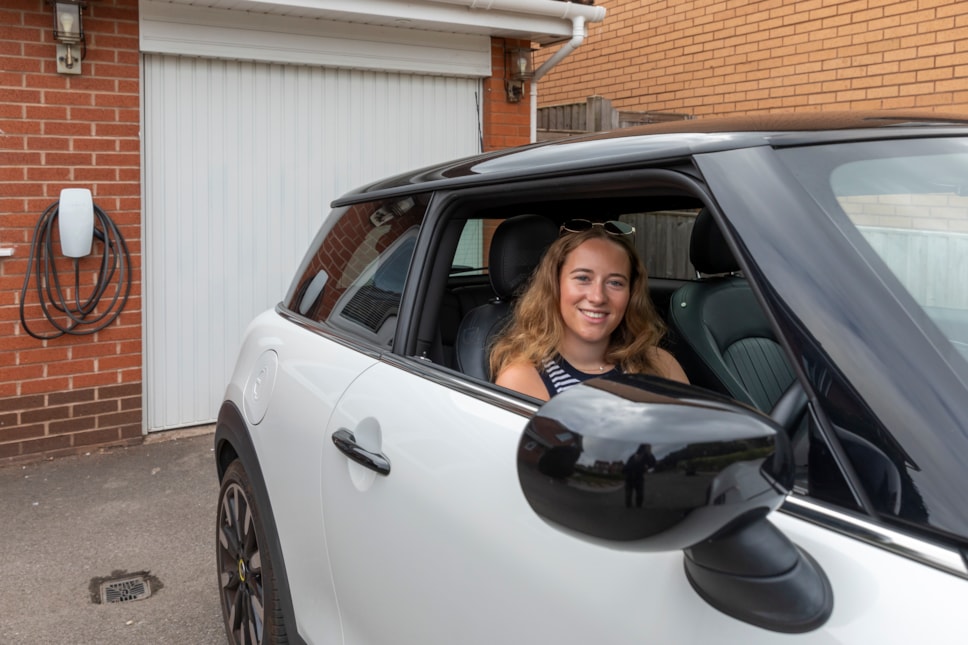
Our pictures feature E.ON Next customer Abi (19), who passed her test in an automatic car and chose to buy an EV as her first car. She is based near Weston-super-Mare in the South West.
What young drivers need to know about electric vehicles: Robert Llewellyn’s tips
- Don’t assume an EV is out of reach – there are now more ways to get into an EV than ever before, including leasing or buying a used EV. In fact, market prices have fallen nearly 10% YoY, helping them become more accessible.
- Consider your everyday journeys – Brits typically travel around 17 miles a day on average, according to YouGov data, meaning many everyday journeys are well within the 150–300-mile range of a modern EV.
- Charge at home to save money – charging at home overnight with E.ON Next’s Next Drive Smart tariff could mean you’re able to fully charge your car for less than £8, a great saving compared with filling a petrol tank.
- Charge where you’re stopped for longest – unlike filling up with petrol, home charging can happen while you're doing something else. Plug in when you get home and by morning, you're ready to go. The time the car spends charging doesn't have to be your time.
- Don't judge today's EVs by yesterday's EVs – vehicle choice, battery range and charging infrastructure have improved rapidly in recent years. If you haven't looked at EVs for a while, you might be surprised by what's available today, and they’re cheaper!
More about Sofia Izquierdo Sanchez’s calculations
*To estimate how much a young driver could save by switching to an EV, economist Sofia Izquierdo Sanchez modelled an illustrative young-driver persona, ‘Callum’, a 19-year-old driver covering 7,000 miles per year.
The analysis compared the annual cost of charging an electric vehicle at home on an E.ON Next EV tariff with the cost of fuelling a comparable petrol vehicle. Four popular entry-level EVs were assessed against broadly equivalent petrol models. For Callum’s profile, the comparison used the MINI Cooper SE and the MINI Cooper S.
Vehicle efficiency data was sourced from EV Database UK, while petrol vehicle fuel economy figures were based on manufacturers’ WLTP combined consumption data. Annual EV charging costs were calculated on the assumption that the vehicle would be predominantly charged at home during the tariff’s lower-cost overnight charging window.
Petrol running costs were calculated using an assumed fuel price of £1.62 per litre. The analysis focuses solely on day-to-day running costs and does not include vehicle purchase costs, financing, insurance, maintenance or depreciation.
Legal information
The information (including any forecasts or projections) contained in these press releases (the "Information") reflects the views and opinions of E.ON on the date of the press release. The Information is intended as a guide only and nothing contained within these press releases is to be taken, or relied upon, as advice. E.ON makes no warranties, representations or undertakings about any of the Information (including, without limitation, any as to its quality, accuracy, completeness or fitness for any particular purpose) and E.ON accepts no liability whatsoever for any action or omission taken by you in relation to the Information. Any reliance you place on the Information is solely at your own risk. These press releases are the property of E.ON and you may not copy, modify, publish, repost or distribute it without our permission. © E.ON 2026
Download images from our media library.