
Flat-out cheaper: E.ON and Allume unlocking the triple benefits of solar, battery and flexibility for millions in social housing for the first time
- Solar+battery+flexibility solution for communal properties aims to cut tenants' power bills up to 60% and unlock extra payments for residents of up to £160 a year.
- Survey finds 80% of Brits want solar and batteries, but one in five (22%) miss out because technology is not suitable for shared buildings.
Millions of people are currently ‘locked out’ of the benefits of generating and storing their own power because they live in flats or social housing. A UK-first shared solar, battery and grid flexibility solution from E.ON Next and Allume is helping to make new energy work for everyone by allowing social housing residents in flats to access cheaper, cleaner power, delivering savings and even extra payments.
More than five million households1 in England and Wales are in flats, including almost half (45%2) of social housing, but most people are unable to benefit from the opportunity to lower their energy bills through solar panels or battery storage because traditional systems cannot fairly share power between homes.
New E.ON polling3 shows more than 80% of people want solar panels and batteries but one in five (22%) say the technology is not suitable for their type of home. At the same time, 70% say it is unfair that some households can cut bills by generating and storing their own power while others cannot.
E.ON Next and Allume’s collaboration is tackling that gap with FlatSave, combining shared solar and communal batteries alongside grid flexibility to make the benefits of new energy available to people who have previously been excluded from rooftop solar, battery storage and flexibility payments.
The solar and batteries allow the power generated by the building to be shared fairly between flats, with an added step of charging the battery from the grid at off-peak times when electricity is cheaper and also feeding back into the grid when demand spikes, reducing pressure on the network at peak times.
By turning communal batteries into a shared asset, FlatSave turns buildings into shared energy assets, helping residents to benefit from the electricity their building generates and stores, and making the energy transition fairer, more affordable and more practical.
The solar and battery system has already been shown to cut a typical household’s electricity costs by 30% to 60%[4]. Using the battery to support the grid could provide a further benefit to residents. E.ON Next customers adopting FlatSave could receive up to £160 a year as an additional cash payment for providing this flexibility. Customers with other energy suppliers could still benefit, with payments of up to £80 a year5.
Ramona Vlasiu, Chief Operating Officer at E.ON Next, said: “FlatSave is a clear example of making new energy work for everyone. By combining shared solar, communal batteries and flexibility we can help people in flats and social housing access cheaper, cleaner power, take more control of their energy use and benefit financially from the energy their building generates and stores.
“Through our strategic partnership with Allume, we’re helping to remove the barriers that have left too many households locked out of the energy transition. This is about turning energy from a cost into an asset for more people, while supporting a smarter, more flexible and more resilient energy system.”
Cameron Knox, Chief Executive of Allume Energy, said: “For housing associations and social landlords, flats are often seen as the most difficult homes to decarbonise because conventional rooftop solar systems have not been designed to share power fairly across multiple meters. “We have been tackling that assumption at scale through SolShare, with over half of our UK installations delivered for social landlords. The approach is being used on more than 10,000 homes globally and has produced 25 gigawatt-hours of green electricity thus far. “The collaboration with E.ON Next takes that one step further, allowing residents to not only save significantly on their bills, but also receive a payment for being able to share that energy back to the grid, too.”
Peabody residents in UK first adoption of FlatSave
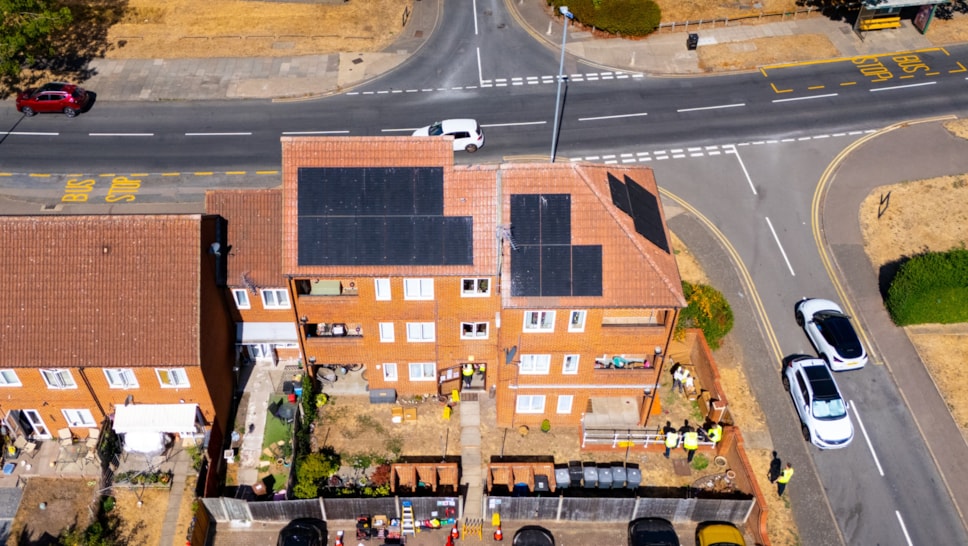
The UK’s first use of the FlatSave solar+battery+flexibility technology has been completed at Harper Court in Stevenage, Hertfordshire, alongside Peabody Housing and the six residents.

The 15kW solar and 18kWh battery will generate and store electricity that can be shared across the six homes and into the local energy grid when needed. All six residents receive the free electricity from the solar generation on their roof. Residents can also sign up for the battery flexibility programme.
Participating E.ON Next customers will receive up to £160 in payments from the battery and participating residents with other energy suppliers can receive up to £80 in payments from the battery.
Future installs are already planned for later this year at housing association properties around the country.
Lorraine, a Peabody resident at Harper Court in Stevenage, said: "Before having the solar panels installed, rising energy costs meant making constant trade-offs. I was having to choose between putting the heating on versus using the oven. When I was cooking, I’d turn the heating off and then turn it back on once I’d finished. The solar and battery system means I don't have to choose between cooking and staying warm.
"The installation process was really straightforward and non-disruptive. The team kept us fully updated of what they were doing the whole time. Everything that is going on with the cost of living makes savings like this huge, and since the solar panels went up, I've been really happy.
"My energy bill has dropped down significantly, which has allowed me to build up a really good credit buffer for the winter months, something I never had before when I was paying monthly.
“On top of those savings, getting the £160 cash payment from the battery will really help my day-to-day spending. Shopping is getting more expensive and I have a few car expenses coming up, so those payments will really help as we head into winter. As people say: ‘every little helps!’”
The system removes the technical and ownership barriers that have long kept many residents in flats from accessing cheaper, cleaner energy. It works ‘behind the meter’ where energy is generated and consumed in the same place, meaning residents can stay with their existing energy provider and no external changes are needed by suppliers or network companies.

The SolShare technology is already being used on more than 10,000 homes globally and has produced 25 gigawatt-hours of clean electricity so far. More than half of Allume’s UK installations have been delivered with social landlords.
E.ON Next and Allume are now working with housing providers, landlords and local authorities to bring FlatSave to more communal buildings, helping more residents access cheaper, cleaner power and share in the benefits of a more flexible energy system. For more information on FlatSave, housing providers can contact flatsave@eonenergy.com
E.ON's Green Funding Solutions team works with local authorities and housing providers to deliver retrofit programmes, including SolShare, battery storage, low-carbon heating and energy efficiency upgrades. The team supports projects from design through to installation and handover, alongside resident engagement and funding support.
Notes to editors
Notes to editors
1 Housing, England and Wales - Office for National Statistics
2 English Housing Survey 2021 to 2022: social rented sector - GOV.UK
3 Nationwide poll of 2,027 people by Clariti for E.ON from 29th April to 8th May 2026
4 Bill savings are modelled from 12 months of metered data (1 July 2025 to 30 June 2026) at Odet Court, Cardiff, a 24-flat SolShare and battery installation (2 SolShare units, 64 kWp solar, 60 kWh battery). Modelling uses the average Ofgem price cap unit rate (26.11p per kWh) and standing charge (54.25p per day) for the period, and the average E.ON Smart Export Guarantee rate (17p per kWh). Across the site, the median per-flat saving with solar and battery is up to 60% of the annual electricity bill. All figures are maximum potential rather than guaranteed and vary by building, system size, tariff, roof orientation, household consumption and Ofgem price cap unit.
5 E.ON Next customers estimated to receive £160 a year from flexibility payments linked to use of the communal battery, including grid charging and use at peak times. That figure is £80 for customers of other suppliers.
Legal information
The information (including any forecasts or projections) contained in these press releases (the "Information") reflects the views and opinions of E.ON on the date of the press release. The Information is intended as a guide only and nothing contained within these press releases is to be taken, or relied upon, as advice. E.ON makes no warranties, representations or undertakings about any of the Information (including, without limitation, any as to its quality, accuracy, completeness or fitness for any particular purpose) and E.ON accepts no liability whatsoever for any action or omission taken by you in relation to the Information. Any reliance you place on the Information is solely at your own risk. These press releases are the property of E.ON and you may not copy, modify, publish, repost or distribute it without our permission. © E.ON 2026
Download images from our media library.