
New London built on old – the challenge of sustainable heat in historic buildings
With history comes complexity, and our engineers had to overcome centuries-old building design to provide a more efficient and effective energy system for one of London’s most iconic buildings
Sometimes old meets new – and the challenge in modernising ancient buildings is not the innovative technology itself, it’s getting the equipment where it’s needed.
Take our City of London heat network which supplies, among other historic and new buildings, the Guildhall.
The Guildhall’s story dates back to when the Romans founded Londinium 2,000 years ago. In its current form its story starts in the 15th century as a place where the merchant class held court, fine-tuning the laws and regulations that established London's wealth. Along the way it has also housed the trial and sentencing of a Queen and lost its roof – twice. First in the Great Fire of London in 1666 and again in the Blitz in 1940.

With all that history comes complexity, and when it came to upgrading the heating infrastructure that sits within the Guildhall, our engineers faced a singular problem – all the plant machinery had to be designed, built, delivered and installed into a plant room that was two storeys underground and accessible through a vertical shaft just 700mm wide.
The works were designed to improve the efficiency of the heating supply to the building – swapping from a single to twin plate exchanger and upgrading the necessary pipework to provide decades more service from this pioneering energy system. The heat exchangers take heat energy from E.ON’s Citigen energy centre ½ a mile away and transfer that heat ready for use throughout the historic building.
Except the old system was likely installed in the 1990s and the ceiling sealed afterwards, which means the only access to the boiler room is via a two storey 800mm wide staircase with tight corners, or an access shaft with direct access but with an even tighter space all around.
Carrying out that tricky task – and equally importantly, doing so in a way that didn’t disturb the work of the Guildhall going on above – meant months of site visits, assessing access routes, design and manufacturing changes, plus out of hours and weekend working to make sure no one else was in the building and being disturbed while we worked.

All this to ensure new machinery would be able to go down the access ladder in the shaft ready for reassembly and installation over the weekend – and, most importantly, was ready for work on the Monday morning!
The details:
- The skid (the metal platform that provides a stable base for all the machinery) was originally assembled off-site to match the floor space available in the Guildhall’s plant room. All pipes were assembled, numbered and then disassembled ready for transport to site.
- Nearly 180 metres of pipework, all 10” in diameter, were prefabricated off site to a maximum of 2 metres in length in order for them to be manageable to get to the plant room.
- Each section of pipe was flanged at the ends so they could be bolted together rather than welded inside the plant room.
- The four end plates – each weighing in at 450kg each (the same as a grand piano!) – and valves went down the shaft individually because of their fragility.
- 400 individual metal plates that sit inside the heat exchanger were also carried down by hand and reassembled one-by-one over a weekend.
And after all that effort, signs of a successful transition are already on display. Even at times of low heat demand, our systems are showing 100% efficiency levels through the new equipment – signs of a more comfortable building, with greater control over the environment.
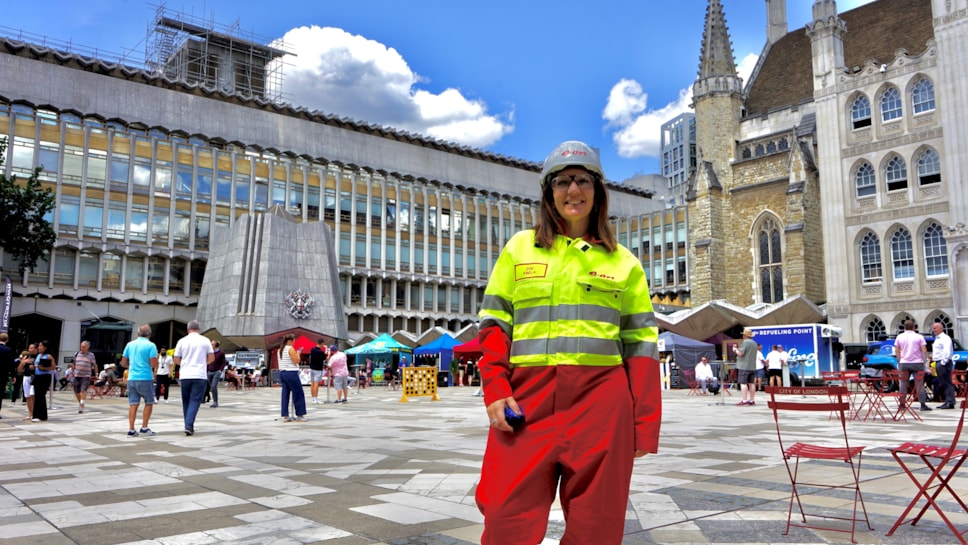
Zoe Abela, engineering project manager at E.ON (main picture), said: “To say this job was a challenge (and exciting) is an understatement but months of meticulous planning, endless measuring, working with two fantastic contractors, and the support of the City of London Corporation, meant the actual delivery of the system was seamless.
“Who knew that getting pipe and a heat exchanger to its final installed place would be the most stressful part of the project – and that the physical installation of 180 metres of pipe and 5MW worth of heat exchanger was the easiest part?”
Today the Guildhall remains the City of London’s civic and ceremonial centre, playing host to royal, national and international occasions, such as state visits and the annual Lord or Lady Mayor’s Banquet.
It is an enduring symbol of London's past and present – only now with a more efficient and effective energy system to keep it running and keep it comfortable.