
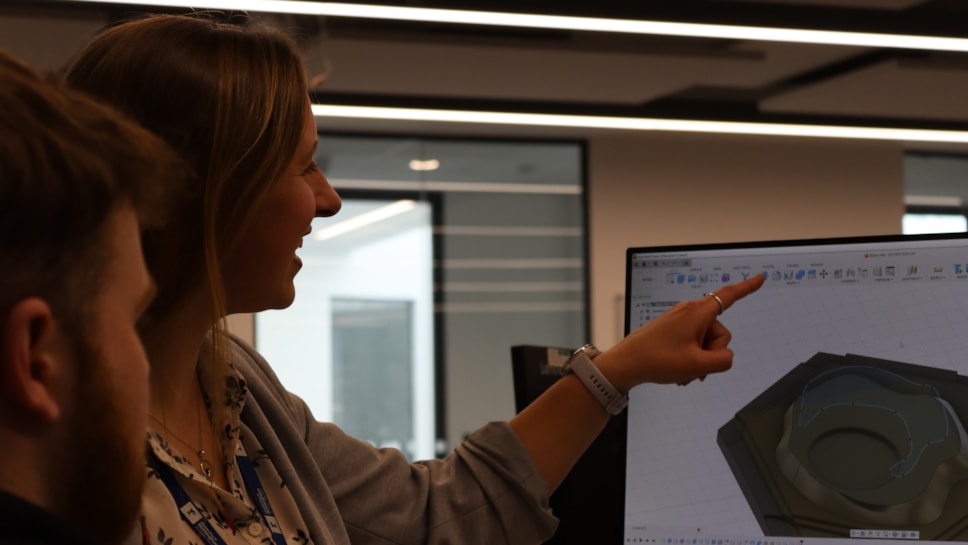
Lighting the path for the next generation of female green engineers
As part of our Lightbulb Moments campaign, we’re celebrating the sparks of curiosity and inspiration that guide women into green energy careers.
Every journey into sustainability starts with a question, a realisation, or a moment when someone sees their future in the energy industry.
So far, we’ve shared the journeys of Alice, Erin, and Lucia - three of our inspiring E.ON Degree Apprentices who each discovered their own lightbulb moment that led them into the world of engineering and green innovation.

Now, we’re turning the spotlight to one of the women helping to nurture that same spark in the next generation: Dr Elizabeth Bishop, Programme Director for the Electro-mechanical Engineer- Degree Apprenticeship at the University of Nottingham a top 40 university in the world for sustainability* home to the country’s largest Electro-mechanical Engineer Degree Apprenticeship programme**, and one of E.ON’s key academic partners.
With a prominent base in Nottingham, and many of our Degree Apprentices studying there, this collaboration symbolises how local partnerships can help build a national pipeline of green skills, innovation, and opportunity.
What first sparked your own interest in your field? Was there a “lightbulb moment” that set you on your career path?
I have always been interested in physics and maths at school, then got into watching Formula 1 and my brain just got hooked on ‘how do things work?’. This, along with some great inspiration from my physics teacher, took me down the engineering path.
How do your programmes at the University of Nottingham encourage students to think about the environmental and social impact of engineering or data science?
We place a strong emphasis on the real-world context of engineering decisions – how every design, process, and innovation has wider social and environmental consequences. From the start of the apprenticeship, our students are encouraged to consider sustainability and ethics as integral parts of engineering design, not add-ons.
Can you recall a student or project that particularly inspired you? One that demonstrated the potential of young minds to drive positive environmental change?
We have so many good student projects, it is hard to focus on just one. From solar panel installations and innovative district heating systems to water quality monitoring solutions, each project approaches sustainability from a unique angle.Together, they demonstrate how powerful young minds can be when given the freedom to explore, experiment, and innovate.
What has really inspired me wasn’t just technical achievement, but the way they approached problems. They are thinking creatively, engaging their teams, and showing that sustainability can also drive innovation and efficiency.
Seeing students realise that their ideas can make a tangible difference in the world reminds me why I love teaching.
What do you think are the biggest barriers, and opportunities, for young women entering STEM fields today?
One of the biggest barriers is still confidence. That feeling of not belonging or of needing to “prove yourself” more than others. I’ve experienced that myself, and I know how powerful it is to have supportive mentors and role models.
The opportunity now is that the culture is shifting. We’re seeing more conversations about inclusion, more visibility of women in leadership and research roles, and a recognition that diversity drives better engineering. There’s never been a better time to step into STEM and help shape what the future looks like.
When your students experience those “aha” moments (whether in a lab, lecture, or project) what do they usually stem from?
Those moments usually come when theory clicks into practice, when they see how the equations, principles, or design tools actually solve a real problem. It often happens during hands-on design challenges or when they prototype and test their ideas.
It’s incredibly rewarding to watch that lightbulb moment when a student realises, “I can do this, I understand how it all connects.” That’s when confidence really starts to build.
If you could give one piece of advice to a young person just starting to imagine a future in STEM, what would it be?
Don’t be afraid to try things and make mistakes as that’s how real learning happens. Every engineer I know has learned more from experiments that didn’t go to plan than from the ones that worked perfectly. Follow your curiosity, ask questions, and seek out opportunities to create and explore. Engineering is about problem-solving, creativity, and persistence – not perfection.
Advice for the next generation
Dr Elizabeth’s message to young people considering a future in STEM is simple but powerful and her final thoughts capture the spirit of our ‘Lightbulb Moments’ campaign perfectly:
“Engineering is for everyone. It’s diverse, dynamic, and deeply human. Whether you love design, sustainability, data, or making things with your hands, there’s a place for you here. I’d love to see more young people, especially women, bringing their ideas, creativity, and voices to engineering and shaping a more sustainable, inclusive future.”
At E.ON, we couldn’t agree more. Through collaborations like this and campaigns such as Lightbulb Moments, we’re working to inspire and empower the next generation of green engineers, right here in Nottingham and across the UK.
Learn more about how we’re building bright, sustainable careers at E.ON Early Careers.
Notes to editors
*QS World University Rankings: Sustainability 2025
**based on starts to the Electro-mechanical Engineer Degree Apprenticeship standard January 2022 – 6 November 2025