
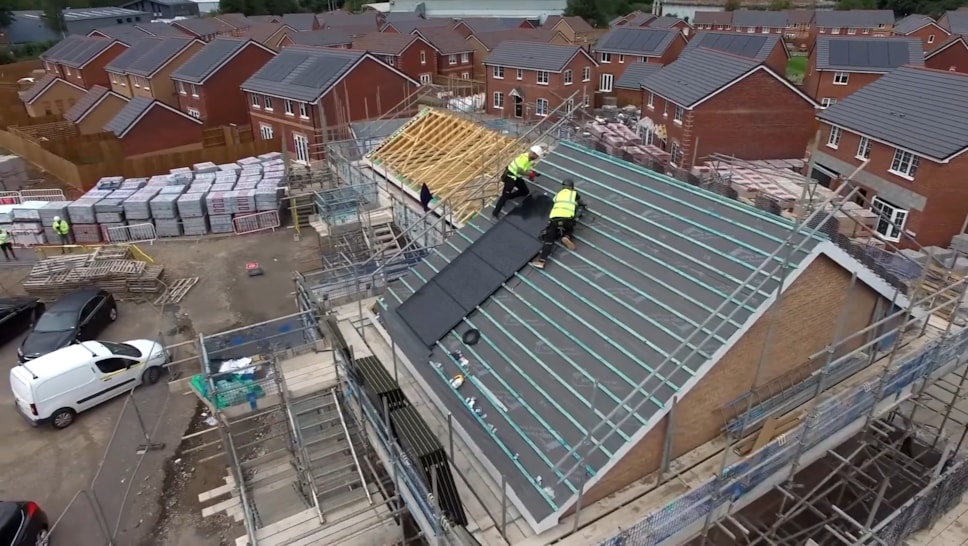
How Eco2Solar and E.ON Next are supporting the Future Home Standard and helping deliver a low-carbon housing revolution
Speaking at the Future Homes Hub national event, Eco2Solar CEO Ryan Mee outlined the scale of experience, capability and readiness they are bringing to the merger transition.
Eco2Solar, now operating as Eco2Solar powered by E.ON Next, has reinforced its commitment to supporting UK housebuilders as the sector moves rapidly towards net-zero-ready homes.
Ryan began by introducing the market scale of Eco2Solar: “We’re the largest volume solar PV installer in the UK and work closely with national housing developers. We are active on around 700 live sites at any one time, completing roughly 150 installations per day.”

Founded in 2007, Eco2Solar specialises in solar PV, home battery systems, EV charging and related low-carbon technologies. Following its acquisition by E.ON Next earlier this year, the company now offers a stronger, integrated solution for the new-build sector. The partnership connects Eco2Solar’s specialist expertise with the wider capabilities of the E.ON Group, from smart metering and connections to whole-home low-carbon solutions.
Event delegates witnessed an insight into the importance of solar tech in the new build sector, with Government Ministers from Department for Energy Security & Net Zero and Department for Levelling Up, Housing & Communities confirming that solar will be central to the Future Homes Standard, and that solar-plus-battery systems will be central to the new Warm Homes Plan.
This clarity aligns directly with E.ON’s mission to accelerate green energy adoption, lower bills for households, and ensure the transition to cleaner homes leaves no one behind.
Reflecting after the conference, Matt Hart, Director of Residential New Build at E.ON Next, said: “The message coming through loud and clear is that clarity and consistency are everything. Developers, installers and homeowners all want the same thing: regulated standards, predictable timelines and the right support to get low-carbon technologies working effectively in real homes. Greater certainty on the timing of Future Homes Standard is something all parts of the industry would benefit from. With that, the transition to the Future Homes Standard becomes not just achievable, but an opportunity to deliver better outcomes for customers.”
Managing regulatory change at pace
Reflecting on the implementation of Part L in England last year (a section of the Building Regulations for England that covers energy efficiency in buildings), Ryan explained how solar went from being installed on around 10% of new homes to close to 90%, driving a dramatic expansion in workload and coordination requirements across the supply chain.
Because Part L is applied plot by plot, many developers could not easily distinguish which individual homes fell under new regulations until late in the build process. This created unpredictable spikes in demand. Eco2Solar scaled up heavily in preparation for increased volumes, then saw activity temporarily stall before a surge in April and May pushed installations to quadruple within three weeks, and double again in July.

Despite the pressure, Eco2Solar delivered. Ryan outlined how, by working alongside E.ON, they were able to utilise up to 5,000 qualified smart meter technicians, ensuring the rapid expansion of labour capacity when developers needed it most.
“Clarity and visibility are essential. When we know what’s coming, the supply chain can invest, train and scale. Developers tell us the same, that certainty of standards and timelines is critical.”
Battery storage, safety and smarter new homes
Ryan also addressed battery safety and system design, noting significant improvements across the industry:
- Modern batteries increasingly include self-extinguishing features
- Loft installations benefit from clearer guidance and robust technical standards
- Retrofit experience shows batteries can be safely installed in a variety of home types
While current Part L systems remain relatively small, the Future Homes Standard is expected to increase solar capacity per home, and with it, the value of integrating battery storage.
Drawing on Eco2Solar’s 18 years of experience in the retrofit sector, Ryan stressed that clear homeowner education will be essential as solar and heat pumps become standard in new homes. Buyers need simple guidance on understanding how much energy their panels generate, knowing when to use electricity rather than exporting it, optimising heat pumps and other electric appliances, and using battery storage effectively.
“People install solar because they want to lower their bills,” Ryan said. “If new homes generate their own power and run heat pumps, we must help homeowners get the very best from that energy. Education is key.”
This focus mirrors E.ON’s broader ambition to make clean energy accessible and easy to use, ensuring no one is left behind in the transition to net zero. Ryan added: “Since merging with E.ON Next, we’ve strengthened our position as a key player in New Build solar and future technologies. Our partnership offers housebuilders simpler, smarter solutions that save time and money.”
Accelerating the future of green homes
With Government direction now clear, industry experience deepening, and Eco2Solar and E.ON Next aligning their capabilities, the new-build sector is entering a decisive phase.
Solar PV and battery storage are set to become core infrastructure for the homes of the future by lowering bills, powering heat pumps, and supporting the UK’s journey to net zero.
As the Future Homes Standard approaches, E.ON and Eco2Solar stand ready to support developers, communities and homeowners, ensuring the move to cleaner, smarter homes is fair, affordable and leaves no one behind.