
Reimagining Britain’s industrial future through an artist’s lens
A UK preview of artist Mark Hearld’s ReIndustrial Revolution artworks at E.ON Next House brought art, energy and industry together to explore how Britain’s next industrial chapter could make new energy work for everyone – delivering lower costs, stronger businesses and thriving communities.
Britain’s industrial landscapes have inspired generations of artists, capturing not just factories and infrastructure, but periods of profound economic and social change.
Now, as the UK considers what the next chapter of its industrial story should look like, E.ON has commissioned acclaimed collage artist Mark Hearld to imagine a new landscape where investment in cleaner, smarter energy supports economic growth, strengthens energy security and makes energy more affordable for businesses and communities.
Created as part of E.ON’s ReIndustrial Revolution campaign, the three collages take inspiration from E.ON projects which are delivering the benefits of new energy: at Silvertown in east London, Blackburn Meadows in Sheffield and the city of Glasgow.

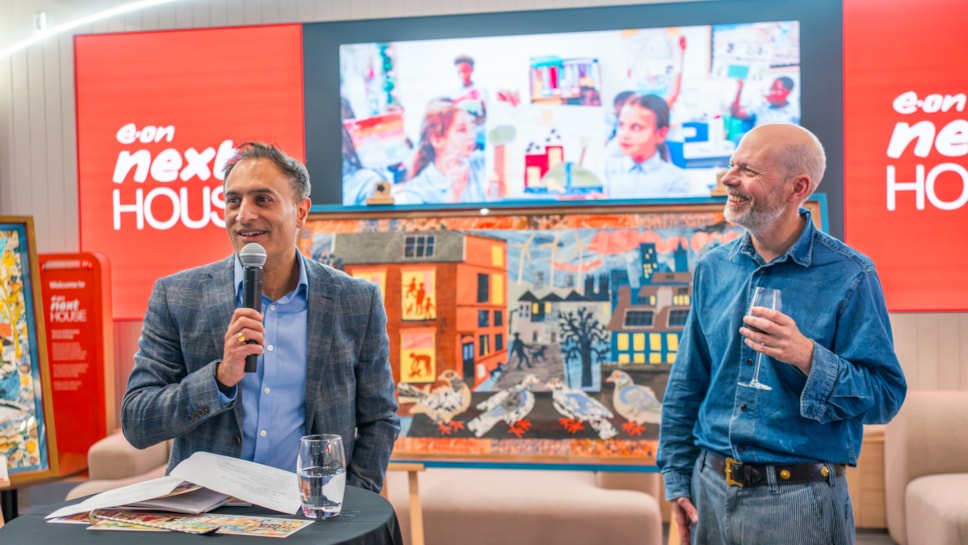
The three collages went on display at an event in E.ON’s London office, where guests saw Mark’s ReIndustrial Revolution artworks and heard more about the ideas and places behind them – a new vision for industry and communities.
Each collage presents a different perspective on how Britain’s industrial landscape could evolve: from sustainable redevelopment at Silvertown to local energy generation alongside nature at Blackburn Meadows, and cleaner, more affordable and flexible home energy in Glasgow through fairer access to new technology.
Together they present an optimistic vision of a ReIndustrial future where industry, communities, new technology and nature can thrive alongside one another, and where the benefits of the energy transition are felt in people’s businesses, homes and neighbourhoods.
Mark Hearld said: “All growth should be sustainable. E.ON’s campaign is a such a positive initiative. I was excited by the dynamic challenge of showing nature flourishing alongside the architecture of redevelopment and greener energy production. A derelict Mill at Silvertown on the Thames about to be redeveloped sustainably, a biomass power station with a ‘black paper cut’ silhouette rising up from a wildflower meadow alive with oxeye daisies in Sheffield, and finally pigeons roosting on the foreground ridge of a roofscape in Glasgow, with its solar panels and home batteries to make energy costs more affordable for low-income families.”

Mark’s works bring that vision to life, showing nature flourishing alongside redevelopment and renewable energy production, from wildflower meadows around industrial infrastructure to solar panels and home batteries becoming part of familiar city landscapes. His Glasgow artwork specifically reflects E.ON’s battery project making energy more affordable for lower-income families.
Behind the artworks sits an important economic challenge: how can Britain move to cleaner energy while reducing costs, strengthening energy security and creating the conditions for sustainable growth?
E.ON’s ReIndustrial Revolution is based on the idea that economic growth, energy security and decarbonisation can go hand in hand. For businesses, cleaner and smarter energy can help reduce operating costs, improve resilience and turn energy from simply a cost to be managed into a competitive asset.
There is strong appetite among businesses to make that transition. E.ON’s polling found 89% of business leaders expect to invest in energy efficiency or low-carbon technologies within the next two years, yet almost half, 48%, identify upfront costs as the biggest barrier to reducing their energy consumption.
That makes affordability central to delivering the opportunity.
Independent economic modelling for the campaign suggests wider adoption of proven technologies such as smart energy management, on-site renewable generation and storage and waste heat recovery could deliver £2.1 billion in cumulative gas cost savings for UK manufacturing between 2027 and 2035.
Those savings could give manufacturers greater confidence to invest, grow and compete - showing how decarbonisation can strengthen, rather than constrain, Britain’s industrial base.
It is a powerful example of how making new energy work can be about more than carbon emissions. Done well, it can help businesses reduce costs, strengthen their resilience and invest with greater confidence, while supporting a more secure and sustainable energy system.
Vijay Tank, Chief Commercial Officer for E.ON Energy Infrastructure Solutions, said: “We do believe there's a bright future for energy. And we do believe we can create solutions for generations to come and inspire generations ahead of us. That's why Mark was commissioned, bringing to life through this wonderful artwork, what we call the ReIndustrial Revolution.
“But there's a serious message here to make UK PLC competitive again. By choosing the right solutions that are available today, we can unlock lots of opportunity - £2 billion in fact for manufacturing. We can help business leaders convert their energy challenges and costs into real assets. To real value that helps reduce the cost of burden that we have today to help overcome, cost disadvantages, and the competitive challenges we see in global market.”

For Mark Hearld, the project also provided an opportunity to make a complex transition feel tangible. A mill brought back to life through sustainable redevelopment. A power station surrounded by wildflowers. Familiar rooftops where solar panels and batteries are helping create a cleaner and more affordable energy future.
These are not only images of a lower-carbon Britain. They raise a bigger question: if Britain is entering a new industrial era, how do we make sure people and businesses feel the benefits?
E.ON’s ReIndustrial Revolution is a call to turn ambition into action – bringing together businesses, government and communities to make new energy more affordable, secure and sustainable. Through Mark’s work, we can begin to picture that future: a stronger industrial Britain in which cleaner energy creates practical benefits for everyone.