
Reimagining Britain’s industrial future – one piece of paper at a time
Britain’s industrial landscapes have always inspired artists. Collage artist and illustrator Mark Hearld reflects on bringing industry and nature together to imagine a cleaner industrial future.
The UK’s next industrial chapter can be powered by cleaner, smarter energy. E.ON’s ReIndustrial Revolution report shows how proven technologies could unlock billions in economic value, although cost and uncertainty remain barriers to investment.
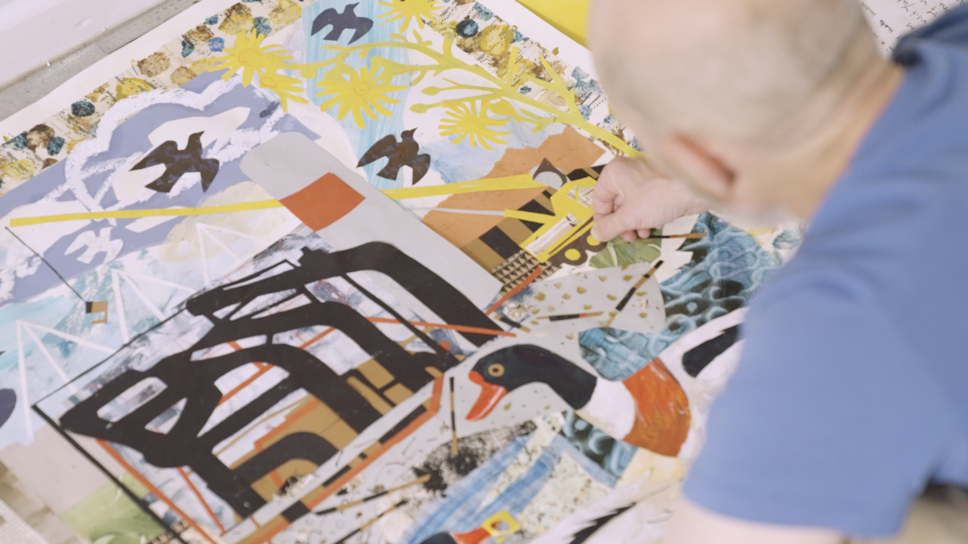
To bring the ReIndustrial Revolution to life, E.ON partnered with artist and illustrator Mark Hearld to create three artworks inspired by Britain’s industrial heritage and reimagined through the lens of modern energy technologies.
How might we picture a new wave of industry that is cleaner, more resilient and rooted in the places where people live? And how could those images show that growth, technology and nature do not have to sit apart?
Each artwork focuses on a different place and perspective: sustainable redevelopment at Silvertown in east London, energy generation and nature at Blackburn Meadows in Sheffield, and cleaner, more affordable home energy in Glasgow.
“It was really exciting to get a brief that actually talked about the images of the Industrial Revolution, and to be asked to create three new artworks showing what the ReIndustrial Revolution might actually look like.
“I’m a collage artist, so I love paper. I love working with paper. This commission gave me the chance to stretch that visual language, combining pipes, power stations, rooftops and solar panels with waterways, wildflowers, birds and people. I was inspired to explore image-making that brought together the elements of industry and the natural world.”

Three places, three stories
Visiting each site helped Mark capture the relationship between its energy infrastructure, industrial heritage and nature.
“Blackburn Meadows was a dream site for a collage artist to work on.” The graphic black biomass plant rises from a wildflower meadow alive with bees and birds. “I wanted the power station and the meadow to feel equally present, because the most hopeful vision is one in which infrastructure and nature can flourish together.”

At Silvertown, a network of pipes allowing buildings to share energy systems, sits alongside the redevelopment of the old mill, historic waterways and docks, with ducks, birds and fish. “The collage became a meeting place between industrial heritage and sustainable redevelopment: the past still visible, but a new use and a new future emerging.”
Glasgow was much more centred on people, homes and communities. “Solar panels and home batteries - real streets with real people were snipped out of paper. And, of course, I added pigeons. I love pigeons, and they’re a dream to collage.”
Making room for young imaginations
Working with E.ON’s New Energy Academy, Mark also visited schools in three of the UK’s key industrial heartlands - Sheffield, Glasgow and the East End of London where pupils created their own collages and shared their ideas for a greener energy future.
“It’s lovely to be making art with children because they begin to use materials really intuitively and they reinvent the wheel with every turn. That’s got to be encouraging for the future.”
“Children care about the world they live in, and it was a joy to see such creative optimism in the collages they made during our workshops. There’s no doubt that their creative engagement has a vital role to play in the future of our world.”

A winning artwork was chosen from each city, reflecting the pupils’ ideas for a greener energy future. Glasgow’s playful drawing and collage surrounded a handwritten welcome to a greener vision of the future; Sheffield’s bold graphic power station stood against vivid colour, distant hills and a wind turbine; while London’s bright composition gave a sense of an entire city on a single sheet of paper.
A future worth picturing
E.ON’s ReIndustrial Revolution campaign gives that creative exercise real urgency. At its heart is a simple idea: how cleaner, smarter energy could help power the UK’s next industrial chapter, helping businesses cut costs, strengthen resilience and turn the energy transition into a driver of growth.
Four in five business leaders surveyed expect to invest in energy efficiency or low-carbon technology within two years. E.ON’s research also shows that measures including energy audits, smart monitoring, on-site renewable generation and storage, and waste heat recovery could save UK manufacturers as much as £2.1 billion by 2035, by switching away from gas and scaling up proven technologies. Yet upfront cost and uncertainty about returns remain significant barriers. The technology is available, but businesses also need confidence, expert support and a clearer understanding of the commercial benefits of investing.
These figures are significant, but art can give an idea a different kind of life. It can help us see what transition might feel like in real places - not as an abstract target, but as part of a landscape, a street or a community.
The ReIndustrial Revolution is not about erasing the character of Britain’s industrial places but helping them evolve - keeping their histories visible while making room for cleaner energy, renewed industry, thriving communities and richer natural habitats.
For UK businesses, innovation can transform clean energy into a competitive edge — cutting costs, decarbonising operations and strengthening resilience. In this vision, sustainability supports competitiveness rather than standing apart from it. It is a future where connected products and services help homes and businesses take control of their energy use and turn the energy they consume into an asset.

If these collages help people picture that future - a mill brought back to life, a power station surrounded by flowers, or a familiar roofscape quietly producing and storing cleaner energy - then they have turned a complex transition into something we can see, discuss and perhaps begin to believe.