
‘How Motorsport’s past is powering a cleaner future’ by Veloce’s Kevin Hansen
Motorsport has always been a catalyst for innovation, pushing the limits of technology, performance, and human ambition.
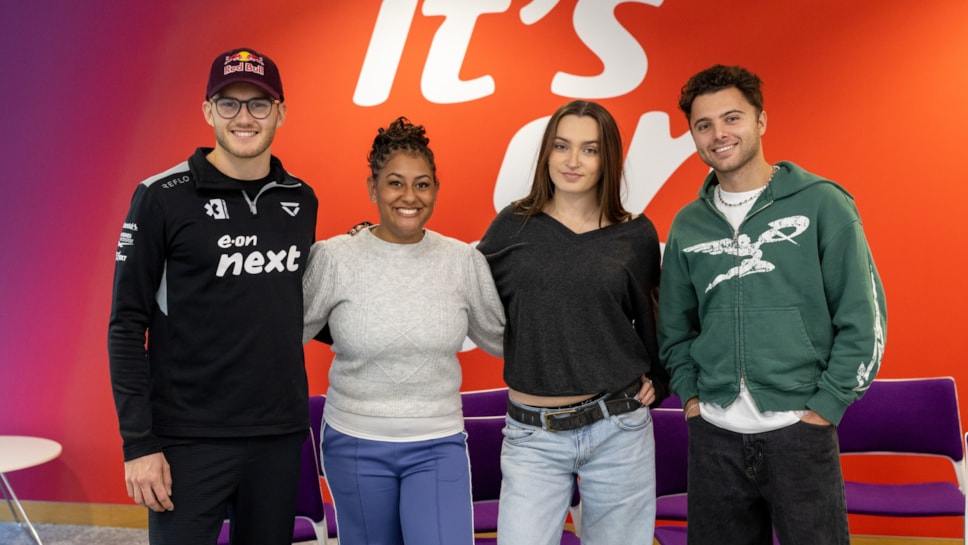
Today, it’s also helping drive the shift toward cleaner, more sustainable mobility — a journey that aligns closely with our mission at E.ON. To celebrate this evolution, we challenged Extreme E driver Kevin Hansen, presenter Steph Wentworth, and Team Quadrant’s Max Fewtrell and Skye Upshall to take part in our electric “Road Trip Through Time.” Starting at the iconic home of British motorsport, Silverstone, the teams retraced key moments in racing history while relying solely on electric power and modern energy-saving strategies.

Here, Kevin Hansen, a winning Extreme E racing driver, shares his own commentary and behind-the-wheel perspective on the journey:
As a racing driver, I don’t often get the chance to slow down and take in the history that brought motorsport to where it is today. But that’s exactly what we did on our “Road Trip Through Time” from Silverstone to the E.ON office in Nottingham, with nothing but an electric car, a map, and our team-mate.
Both squads were driving electric cars, racing not for a chequered flag but for bragging rights and the glory of arriving first at the home of one of the leaders in clean energy. If you put two competitive teams in cars, call it a race, and throw in some challenges, you know it’s going to get interesting!
We kicked off exactly where Formula 1 did, in Silverstone, and the first challenge was inspired by 1950 - the year the first F1 World Championship race was held. There was something poetic about setting off from the birthplace of modern motorsport in futuristic electric cars.
Our task was a tribute to the olden days with a modern twist – putting on an item of vintage clothing and taking a selfie. And yes, Team Hansen completed the challenge first, earning a perk which allowed us to freeze the other team’s journey for five minutes.
Next up, we dove into the legendary rivalry of James Hunt and Niki Lauda from 1976. That season is etched into motorsport history for its drama and sheer grit - and this challenge captured the spirit of racing where every turn counts.
Modern motorsport, even with all its technology, is still all about two rivals fighting for glory and pushing each other to be better. In this case, that rival was Team Fewtrell, who were the first to take three right turns in a row to earn 60 seconds of GPS.
We jumped from Formula 1 into the chaos of Group B rallying in 1985. Nothing will ever quite match the outrageous power and danger of that golden era, but our challenge still forced us out into the wilderness in a sense. We had three minutes to find the highest geographical point that we could, and Team Hansen’s 130 metres of altitude won full use of GPS at a key turning point in the road trip.
As a rallycross driver, that one felt like home turf. Group B may be gone, but its spirit lives on in every off-road racer who loves sliding, jumping, and wrestling a car for every tenth.
The 1990s brought us to Le Mans: where endurance and efficiency are everything. This next challenge wasn’t about pure speed, but about how every detail matters, and Team Fewtrell were the first to solve the riddle and level the playing field with full access to GPS for themselves.
Learning how to stretch performance sustainably is something motorsport has been refining for decades, long before sustainability became a global talking point. By the time we reached the 2010s, we were into the era where hybrid power transformed the motorsport landscape.

If the earlier challenges were about nostalgia, this one marked the transition to the world we race in today, which is all about strategy, data and energy management - which hit close to home given we were driving electric cars.
In the spirit of strategy and data, the fifth challenge was a quiz, and I found myself with a slight advantage when one of the questions was about my childhood hero and former team-mate Sébastien Loeb (a nine-time World Rally Champion!).
Motorsport has always been a test bed for innovation, and hybrid technology proved that sustainable solutions could also deliver performance. It’s a reminder of why I believe so strongly in the role motorsport can play in shaping a greener future.
Our last challenge celebrated 2020, when motorsport had truly embraced electric power with the likes of Formula E. I’ve seen first-hand how electric racing has transformed the sport and opened new doors for sustainability and technology from racing in Extreme E with E.ON Next Veloce Racing.
The first team to spot three different kinds of eco-friendly tech would win the final perk, and Team Hansen sealed the deal in the last leg of the trip with five minutes taken off our journey time upon arrival.
Motorsport has been a leading power in environmental and tech advancement. It is there to push boundaries, and I think the more sustainable solutions we can find the better – and that gets the next generation excited to see if they can push things even further.

Of course, the road trip wasn’t just about sustainability. It was also about the people who will shape motorsport in the decades to come. Progress isn’t only technological - it’s social as well.
It was amazing to hear about Steph’s journey in motorsport, and I believe women, like my team-mate Molly Taylor too, have such an important role to play. Motorsport has finally woken up to the responsibility it carries. We’re not just racing cars, we’re also racing against perceptions, barriers, and old ideas about who belongs.
Our journey ended at the E.ON office in Nottingham, a symbol of the clean-energy future we all want to accelerate toward. The road trip didn’t just celebrate motorsport history, it connected it directly to the values that will define the next era: sustainability, equality, and innovation.
And yes, because I know you’re wondering, Team Hansen made it there first. But this was more than a race. It was a reminder that the road ahead is just as exciting as the one behind!
Leading the way forward

The teams’ journey from Silverstone to our Nottingham office highlighted the powerful connection between motorsport’s pioneering spirit and the clean-energy future we’re building. Each challenge celebrated a chapter in racing history, while demonstrating how sustainability, inclusion and technological advancement are shaping the next era of mobility.
We’re proud to support the ideas and people driving this transformation — on the road, on the track, and within the communities we serve. The race may have ended at our doorstep, but the momentum toward a brighter, more sustainable future continues, and we’re excited to keep leading the way forward.