
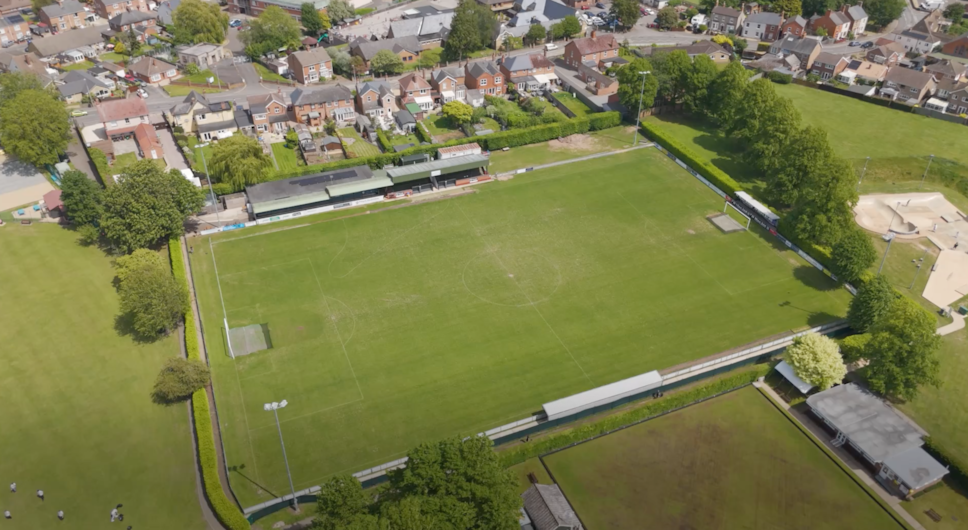
How grassroots clubs like Bourne Town FC are helping secure football’s future
Lower energy costs are creating new opportunities for clubs to invest more in their communities, facilities – and the next generation of players.
After football captured the nation’s imagination this summer, another story is unfolding away from the game’s biggest stages.
It is one about volunteers unlocking clubhouses before dawn, about coaches marking pitches after a day’s work and about committee members organising fixtures.
And increasingly, it is about finding new ways to make grassroots football financially sustainable.
For clubs such as Bourne Town FC, that challenge has become just as important as results on the pitch.
Founded in 1883 and home to 16 junior teams, two senior sides and a veterans’ team, Bourne Town FC has spent well over a century at the heart of its local community.
Today, hundreds of players pass through its historic Abbey Lawns ground every week – with football serving as a focal point for families, volunteers and local organisations alike.
Like many grassroots clubs across England, however, rising energy costs have become one of the biggest pressures facing the club.
Floodlights, refrigeration, heating, clubhouse facilities and everyday maintenance all come with ever-growing costs – placing increasing strain on volunteers whose focus has always been providing opportunities for local people.
It is exactly these kinds of challenges England Football’s Greener Game programme, supported by E.ON Next, was designed to tackle.
The long-term initiative invests £1.5million every year into helping grassroots clubs reduce energy costs through measures including solar panels, battery storage and expert energy advice – allowing clubs to reinvest savings where they matter most.
For Bourne Town FC, the impact of the energy-saving installations that came with it signing up to the Greener Game programme has been immediate.
Mark Lynch, Chairman and Secretary at Bourne Town FC – and pictured below, far right, at the club’s ground with one of our engineers – told us: “The support that E.ON have given us through the Greener Game incentive has been valuable to the club.
“We’re not scared anymore to have to switch the lights off or turn the refrigerator off because the costs are building up in the off season.
“We know now that we’ve got a sustainable utility that we can keep running throughout the year.”

Money which once disappeared into utility bills can instead support coaching, equipment, facilities, youth football or wider community activities.
Mark says that is already becoming a reality at Bourne.
He added: “The savings we’ve made through the Greener Game incentive have provided more stability, more financial security for the business and more independence in terms of our reliance on the utilities.”
Those savings are changing far more than the club’s balance sheet.
With lower running costs, Bourne Town has been able to expand how often its facilities are used, opening the doors to new groups and generating additional income that can be reinvested back into the club.
Mark explained: “We’ve been able to open not just on match days, we’ve been able to open for other events, we’ve been able to hold social events and we’ve had business that have come down and used it as a training centre. So, really, the list can be endless now.”
That wider community impact sits at the heart of the Greener Game programme.
Grassroots football clubs increasingly serve as community infrastructure as much as sporting venues – bringing people together, supporting physical and mental wellbeing, creating volunteering opportunities and providing safe spaces for young people to develop confidence, friendships and life skills.
Helping those clubs become financially resilient is about much more than reducing energy bills.
It is about protecting the future of the communities they serve.

Stephen Elger, President of Bourne Town FC – now fitted with solar panels, above – has witnessed the transformation first-hand.
He said: “Overall, I’d have to say getting involved in the Greener Game has been a win-win, both for me as the club is close to my heart, and for Bourne Town Football Club.”
Stephen also told how the process was smooth after the club applied to the programme, with E.ON Next rapidly carrying out an energy audit before recommending the installation of solar panels and battery storage at the club.
He added: “I’m president of the club, and we spend most of our days – or at least five or six hours a day down here – doing all the maintenance works.
“Our ex-chairman said he could get a grant for the Greener Game. E.ON Next came down and did an audit, and we were offered solar panels and a battery.
“Two guys came and put the panelling up on the roof, the electrician came at the same time. While they were putting the solar panels up on the roof, the electrician was running all the cabling, and it all sort of went swimmingly.
“The installation was done within six or seven hours – absolutely fantastic and super-efficient.”
The technology now allows the club to generate and store much of its own electricity, automatically switching between solar power, battery storage and the grid depending on conditions.
As Stephen sat in front of the app that showed the effects of the solar panels and battery power on the club’s energy usage, he said: “Basically that just switches from solar to mains depending on what solar gain and what battery power we've stored.”
At one point, the live data showed the club drawing no electricity from the national grid.

Stephen – pictured above with the technology – said: “We’re not taking anything off the grid – it’s nil cost to us at this time.
“The app tells you everything that you need to know.”
For volunteers responsible for keeping community clubs alive, those numbers represent far more than technological progress – they also represent certainty.
For Mark, the message to other grassroots clubs is straightforward.
He said: “It’s going to benefit you as a club, and it’s going to allow you to use that revenue elsewhere in a more cost-effective way.”
This summer produced unforgettable moments on football’s biggest stages.
But meanwhile, clubs such as Bourne Town FC were still busily preparing pitches, welcoming players, opening their doors and creating opportunities for the next generation.
Because football’s future is not built only under the floodlights of stadiums.
It is built in places such as Abbey Lawns, where community, sustainability and the love of the game continue to come together every single week.
Click here for information on how to join the Greener Game today and see how eligible clubs have the power to save money and energy.
And click here to learn about our Watch & Wash campaign – which sees England legends highlight £93million in potential fan savings tied to off-peak electricity use around this summer’s kick-offs.
Legal information
The information (including any forecasts or projections) contained in these press releases (the "Information") reflects the views and opinions of E.ON on the date of the press release. The Information is intended as a guide only and nothing contained within these press releases is to be taken, or relied upon, as advice. E.ON makes no warranties, representations or undertakings about any of the Information (including, without limitation, any as to its quality, accuracy, completeness or fitness for any particular purpose) and E.ON accepts no liability whatsoever for any action or omission taken by you in relation to the Information. Any reliance you place on the Information is solely at your own risk. These press releases are the property of E.ON and you may not copy, modify, publish, repost or distribute it without our permission. © E.ON 2026
Download images from our media library.