Disability Pride Month: How we are building a workplace where everyone belongs
From award-winning business initiatives to immersive real-world experiences, E.ON is turning empathy into action by removing barriers and creating opportunities for colleagues, customers and communities.
July’s Disability Pride Month is coming to an end, and since its inception in 1990 it has grown into a global movement, designed to challenge outdated perceptions of disability.
It also champions identity and rights – while reminding us all accessibility should be built into every workplace, not added as an afterthought.
That message has never been more important.
Three in four (75%) of disabled people have experienced negative attitudes and behaviours in recent years because of their conditions, while 24% of the UK’s working-age population are classed as disabled – representing approximately 9.8 million people.
At E.ON, creating a workplace where everybody belongs means recognising those barriers and actively working to remove them.
We believe progress is achieved when people from every background, experience and ability are empowered to contribute is central to our continued mission to help lead the UK’s cleaner energy transition.
For us, inclusion is not viewed as a standalone initiative, but as a business priority shaping how colleagues are supported, helped to develop and given opportunities to thrive.
That long-term commitment continues to receive national recognition.
It’s why E.ON has been named in the Inclusive Top 50 UK Employers for 10 consecutive years and secured sixth-place in the awards in 2025 – making us the only energy company featuring in the list.
We are also a Disability Confident Employer, helping remove barriers into work for disabled people, while our inclusion work contributed to our recognition as one of The Sunday Times Best Places to Work 2026, ranking in the UK’s Top 10 for the second consecutive year and earning a Highly Commended distinction in the Best Places to Work for Women category.
These awards are based solely on colleague feedback and sustained investment in creating a culture where everyone feels they belong.

As Chris Norbury, Chief Executive of E.ON UK – pictured above launching our Purpose Coalition Report – said after the latest Best Places to Work accolade: "Great workplaces are built by great people – and this award reflects that. The fact this recognition comes straight from our people makes it incredibly meaningful.
“Every day, colleagues across E.ON use their skills, ideas and care to support customers, communities and the UK’s energy transition. This recognition reflects a culture where people feel valued, included and able to grow, and I’m immensely proud of all the colleagues working together who make E.ON such a positive place to build skills and make a real difference.”
That culture is supported by more than 4,500 colleagues participating across nine colleague-led inclusion networks, covering everything from disability and neurodiversity to race, menopause, fertility, working families and LGBTQ+ inclusion.
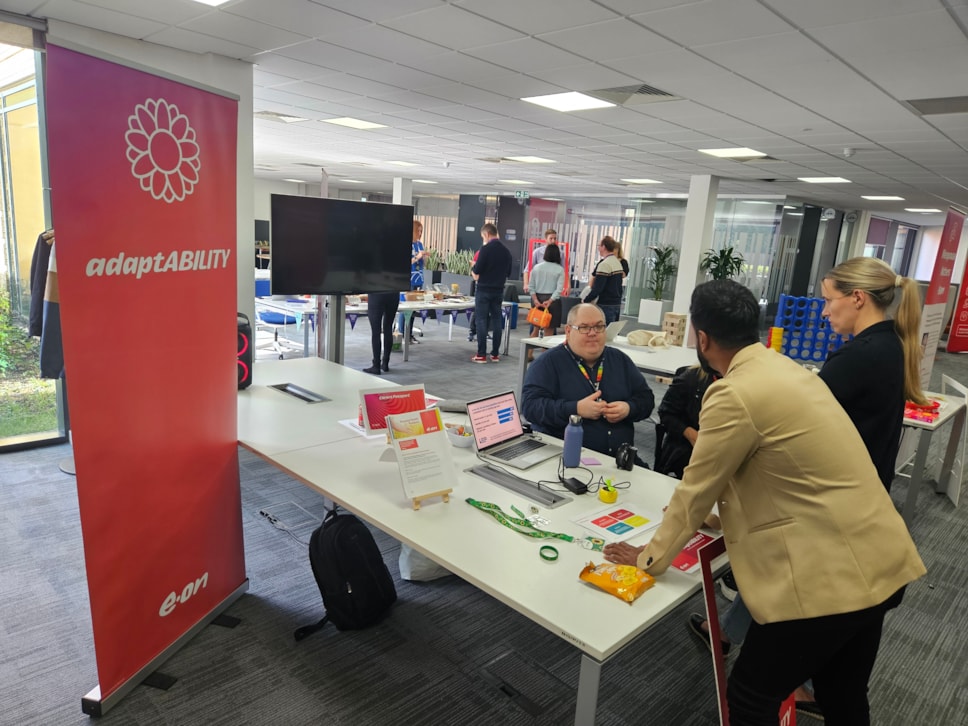
Central to Disability Pride Month is adaptABILITY, our disability network, which now has more than 500 members.
All our inclusion networks are colleague-led and everyone is welcome.
Our adaptABILITY network provides a voice and community for colleagues with visibile and invisible disabilities, as well as for those with chronic illnesses and long-term health conditions – and to allies and managers, where experiences can be shared openly while helping shape company policy through lived experience.
Its influence has already delivered tangible improvements.
Members also regularly host expert speakers covering subjects ranging from managing fatigue and chronic pain to remaining active with long-term health conditions.
The work reflects a wider understanding disability is often invisible.
Wider research from the Deloitte Disability Inclusion at Work Report, along with polling by the Trades Union Congress (TUC), show around 41% report experiencing bullying, microaggressions or harassment.
The figures also reveal nearly a quarter have had their competence questioned, while 24% say they have been overlooked for promotion.
And 44% miss workplace events because they are not fully accessible, while only around one-third believe they have received the workplace adjustments they need.
The statistics also show fewer than half report having visible role models with disabilities.
Based on our colleague feedback and drawing on this external research, our adaptABILITY network is changing those experiences through one of E.ON's most innovative internal awareness programmes – The OffCentre.
Created by members of the adaptABILITY network, The OffCentre encourages colleagues to step into the world of people living with both visible and invisible disabilities through a series of practical simulations and personal stories.
Participants wear specialist goggles – pictured below – which replicate a range of visual impairments, including tunnel vision, blurred vision and light sensitivity.

Weighted vests recreate the fatigue associated with chronic pain and long-term health conditions.
Heated garments simulate temperature dysregulation experienced by people living with conditions such as multiple sclerosis, while breathing exercises demonstrate the daily challenges faced by those with respiratory or anxiety-related conditions.
Alongside these immersive experiences are powerful first-person stories from E.ON colleagues, illustrating how disability can affect careers, confidence, relationships and wellbeing – and how the right workplace support can transform those experiences.
Anthony Ainsworth, Chief Operating Officer of Industrial & Commercial at npower Business Solutions and E.ON UK Board sponsor of the adaptABILITY and Neurodiversity networks, believes initiatives such as The OffCentre are changing conversations across the business.
He said: “The OffCentre initiative is one of the most impactful things I’ve seen when it comes to building genuine empathy across a workforce.
“Too often, disability is misunderstood or oversimplified – especially when it’s invisible. What this programme does so well is bring the human side of the conversation to life in a way that's deeply personal and undeniably powerful.”
Anthony – pictured below – added: “I’ve always believed that diversity fuels better decisions and stronger teams.
“But it’s not enough to simply have diverse teams – we need to maintain workplaces where everyone feels they belong.
“The OffCentre has challenged assumptions, encouraged compassion, and reminded us all that inclusion is everyone's responsibility.
“And as leaders, we have a duty to create the kind of workplace where every individual can contribute and thrive.”

As part of our wider commitment to raising awareness around disability and accessibility – and through our partnership with The FA, we worked with the England Blind football team to create an immersive experience which challenged perceptions in a very different setting.
Swedish rallycross driver Kevin Hansen swapped the cockpit for a blackout mask at St George’s Park, joining members of the England Blind Football team to experience elite sport without sight, as pictured below.
For a driver accustomed to making split-second decisions at over 100mph, every movement suddenly depended on trust, communication and sound.
Kevin said at the start of our video of his training session with the blind athletes – which is available here: “When I am racing, I have someone in my ear giving me advice on racing lines, so I really have to double into that and trust even more what is in my ear.”

“It was the hardest thing I’ve ever experienced,” a visibly moved Kevin admitted afterwards. “It was a humbling experience and what the players do on the pitch is incredible.”
His experience offered a glimpse into a sport built entirely around communication and teamwork.
England international Roy Turnham, who has earned more than 100 caps, believes opportunity remains the biggest challenge facing many disabled people.
“When I was growing up, there wasn’t really a structure for blind football,” he said. “We have amazing coverage now of some of the major tournaments – and look at how the Paralympics is covered, it’s fantastic
“There’s a lot of low expectations around what someone can do if they have any disability. Whether it’s the person themselves or people around them not knowing things like blind sport are available.”
Forward Efe Shimwell, who discovered the sport after his mother encouraged him to attend a local session, described it as life changing.
“I was really lucky to discover blind football,” he said. “By complete chance, I just fell in love with it straight away.”
Blind England international Lucja Wyrwantowicz echoed that sentiment.
“This whole sport relies on communication between everyone,” she said. “Being able to do a sport you love is massive. Finding blind football and finding a community is massive – it has given me a massive amount of confidence.”
For goalkeeper Megan Smithson-Booth, the sport provides something many people take for granted.
“Running around the pitch and having that freedom to run around – you don't generally get that outside of blind football,” she said. “It gives you a huge purpose.”
Those stories reinforce the same lesson sitting at the heart of this year’s Disability Pride Month.
Whether through colleague-led networks and workplace policies, immersive learning experiences such as The OffCentre or opportunities to experience the world through someone else’s perspective on a football pitch, we believe inclusion begins with understanding.
Because building a fairer energy future isn’t only about transforming infrastructure.
It’s about creating workplaces and communities where everyone has the opportunity to contribute, succeed and belong – all of which is vital to powering the energy transition.
To learn more about diversity, equity and inclusion at E.ON, click here, with our full 2025 Inclusion Report here.
Legal information
The information (including any forecasts or projections) contained in these press releases (the "Information") reflects the views and opinions of E.ON on the date of the press release. The Information is intended as a guide only and nothing contained within these press releases is to be taken, or relied upon, as advice. E.ON makes no warranties, representations or undertakings about any of the Information (including, without limitation, any as to its quality, accuracy, completeness or fitness for any particular purpose) and E.ON accepts no liability whatsoever for any action or omission taken by you in relation to the Information. Any reliance you place on the Information is solely at your own risk. These press releases are the property of E.ON and you may not copy, modify, publish, repost or distribute it without our permission. © E.ON 2026
Download images from our media library.