
Achieving green goals: how an iconic stadium kicked off gas to go all-electric
Sparta Rotterdam’s stadium, Het Kasteel (The Castle) is one of the most iconic football stadiums in the Netherlands – dating back to 1916 and one of the country’s most historic stadiums.
Het Kasteel holds a capacity of 10,599 people and is named after the castle that still forms part of the main stand. It is home to Sparta, the oldest professional football team in the Netherlands which dates back to 1888.
But it’s the future, rather than past, which makes The Castle more interesting. A partnership with energy company Essent (part of E.ON) is making the stadium completely sustainable. This partnership, set to run for the next 30 football seasons, marks a significant goal in advancing green energy within the sports sector.
Over the last year, as sustainability partner, Essent has significantly reduced the environmental footprint of Het Kasteel, making Sparta’s home not only one of the oldest football stadiums in the Netherlands, but also among the most sustainable.
"A professional football organisation is at the heart of society and is often seen as an example of social challenges,” says Manfred Laros, General Manager of Sparta Rotterdam. “With the exemplary role that Sparta Rotterdam has, also in the field of sustainability, we thought it was important to investigate how we could make Sparta Stadium 'Het Kasteel' gas-free."
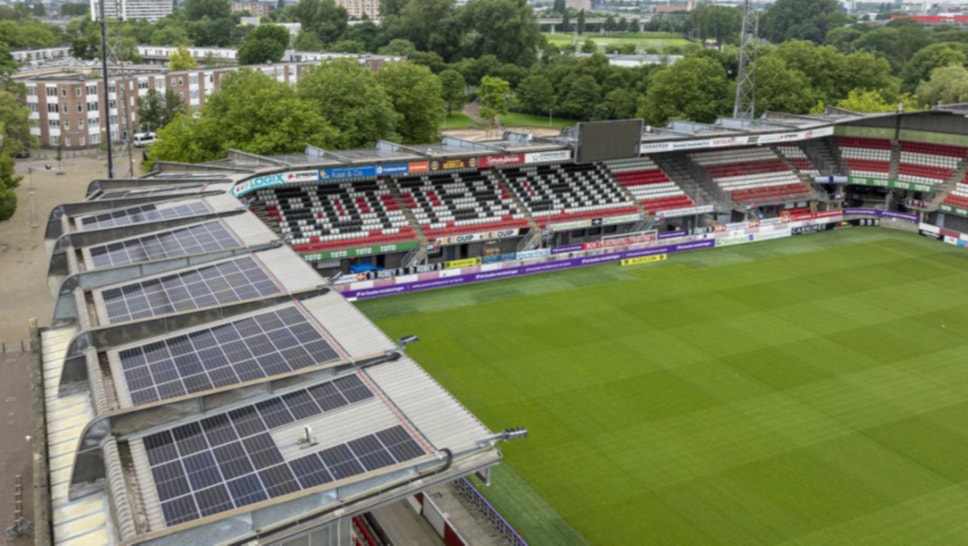
To kick off the sustainable energy transformation, 1,200 solar panels, able to generate around 600MW of electricity each year, were installed on the stadium roof. This solar energy is used to power the stadium’s own consumption and to operate its energy solutions. Making the stadium all electric and bringing a new era to the club which ensures the stadium remains top of the league for sustainability.

Installed heat pumps and an Aquifer Thermal Energy Storage (ATES) system mean the stadium can store heating and cooling underground, (almost 1,500kW of heat and 750kW of cooling). What’s more this system significantly reduces the overall energy demand by reusing the stored heat and cold.
Het Kasteel is now completely gas free – saving 100,000m3 of gas previously used to heat the pitch and stadium each year. And thanks to Essent’s investment around 188 tonnes of CO₂ emissions are saved each year – that’s equivalent to driving a petrol car around the earth 30 times.
“The sustainability of Het Kasteel is a model for other football stadiums,” says Walter Grootveld, Director of Essent Infrastructure Solutions. "I’m extremely proud of this project. By making Het Kasteel more sustainable, we are showing how sport and sustainability reinforce each other."
This winning collaboration puts Sparta Rotterdam’s home ground in the spotlight as a forward-thinking player in the match against climate change.
In the UK as sustainability partner to Premier League club Nottingham Forest, E.ON is helping them to reduce their carbon footprint. E.ON Next is also working in partnership with The FA to support grassroots football through the Greener Game Decarbonisation Fund aimed at making community clubs’ facilities more energy efficient.
In the last year 250 amateur clubs have signed up to the Greener Game, with 22 already set to have energy solutions installed – tech like solar and batteries to generate and store electricity. Results of this initiative also show four grassroots football pioneers to have almost collectively saved £10,000 by cutting their energy usage up to 25%.
And it’s not just in Europe, stadiums across the world are stepping up to the challenge of sustainability, proving that the beautiful game can be a green one too.